


A year after Southern Water admitted responsibility for the bio-bead spillage at Camber Sands, the clean-up continues.
What happened?
For years, Camber residents had occasionally found small plastic beads on the beach. But on 27 October 2025, large quantities began washing ashore.
A major clean-up operation was launched, involving volunteers, Strandliners, Nurdle and Rother District Council. On 6 November, Southern Water admitted that damage to a retaining grid at its Eastbourne treatment works had resulted in 4.6 tonnes, or approximately 300 million, of its water-treatment bio-beads being released into the sea over a two-week period. Southern Water joined the clean-up operation on 10 November.
What’s the problem?
Many tonnes of nurdles, pea-sized plastic pellets used in countless products, are spilled into the oceans every year, and some fish and birds, including fulmars, mistake them for food. This spill of bio-beads was particularly serious, and the Environment Agency categorised it as a Category 1 pollution incident.
Bio-beads are small enough to be eaten by birds and other wildlife, and pets and humans could also be at risk. They are often made from waste plastic recycled from the electrical industry rather than from new plastic, and scientists at King’s College London found traces of heavy metals in plastic pellets washed up at Camber Sands. To date, no bird deaths have been directly attributed to bio-beads.
But how do you collect an estimated 300 million tiny plastic beads once they have entered the natural environment?
Inspired and organised by Strandliners, a local Community Interest Company, Rother District Council and Nurdle, a specialist team with a giant towed vacuum cleaner, volunteers spent many hours collecting what they could from Camber Sands with buckets and brushes, joined some days later by Southern Water staff.
Tides had also carried beads into the old saltmarsh and, to a lesser extent, the flooded gravel pits of the Rye Harbour Nature Reserve, where recovery without damaging the delicate ecology was harder still. High spring tides and storms kept depositing more beads, and the needs of tourism and nesting birds meant that large-scale recovery work largely stopped for the summer. By then, 1.7 tonnes, or more than 100 million beads, had been collected, a remarkable achievement.
Is the clean-up continuing?
Recovery work on Camber Sands restarted in October 2026. George Taylor of Southern Water was keen to stress that, “It’s not being triggered by any new spill, an increase in material on the beach or any expectation that more beads will wash up.”
However, after so many months of wind, waves and tides, the millions of beads still uncollected may have blown into the dunes, been temporarily buried in the shifting beach sand or become further dispersed.
GLE Environmental Ltd and Nurdle are using newly designed, heavier equipment to sift areas of the beach to a depth of 40cm. Concentrating on the strandline, the team is currently working westwards from the middle of the beach.
In October 2026, vital beach-cleaning equipment, including three quad bikes, was stolen from Nurdle’s lock-up. Rother District Council, which is working with the police and appealing for information about the theft, said on its website, “Without this equipment, Nurdle’s ability to continue its crucial environmental clean-up operations has been severely impacted.”
While the work at Camber Sands will help reduce the risk of further contamination of the Rye Harbour Nature Reserve, a resumption of cleaning in the more delicate contaminated nesting areas is also planned for early spring 2027.
What has Southern Water been doing?
In addition to assigning some of its own staff to the operation, Southern Water has funded the work of the GLE and Nurdle team.
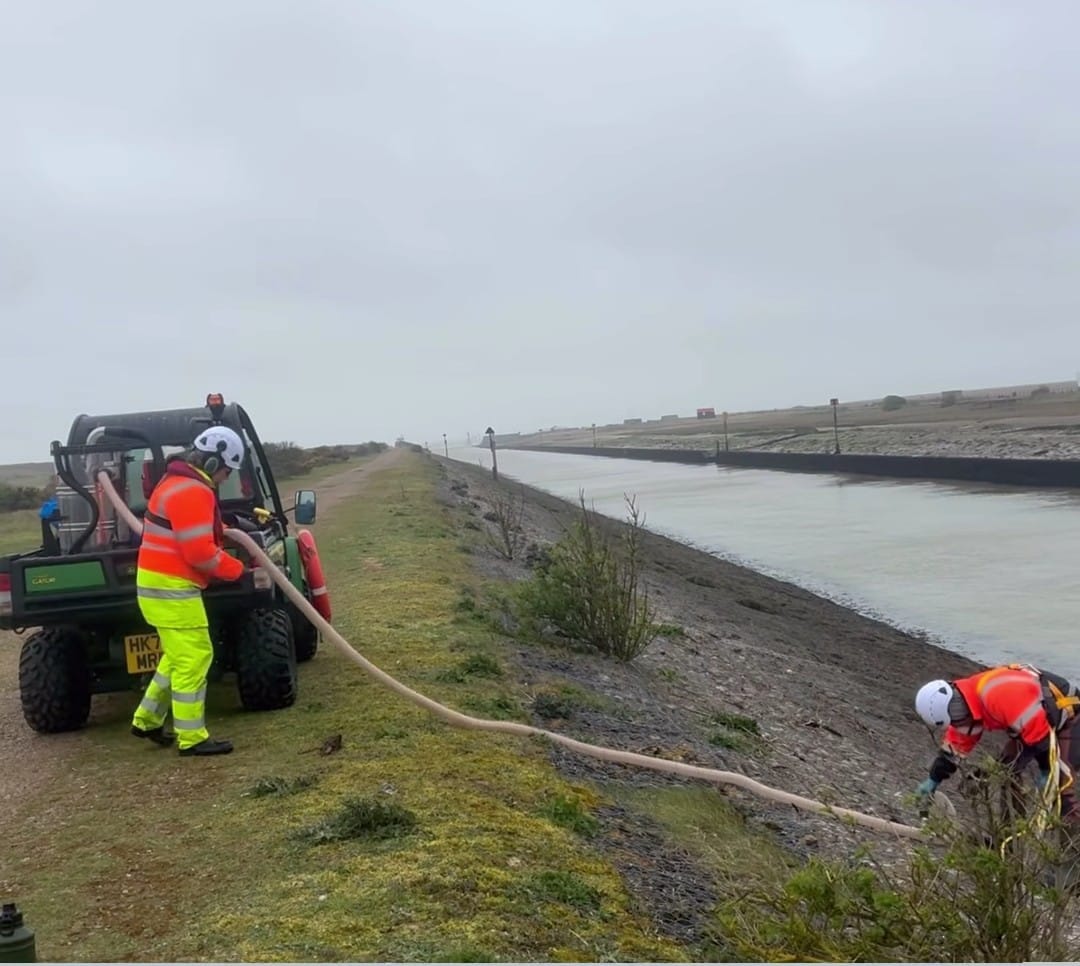
Additional monitoring equipment has been installed to reduce the risk of another major accidental spillage going unnoticed.
An Environment Agency spokesperson said, “This remains an active investigation, and we will not hesitate to take robust enforcement action where appropriate.”
Helena Dollimore, Labour and Co-operative MP for Hastings, Rye and the villages, said:
“In the wake of this incident I made Southern Water promise to clean up its own mess and make amends to our community and our wildlife. I have been holding them to that promise and a package of compensation for local projects is underway. This does not take away from the Environment Agency’s ongoing criminal investigation, and it is right that Southern Water face the full force of the law for this disaster.”
Rye News was given no indication of when the investigation report would be available.
The spillage and subsequent clean-up have resulted in substantial direct and indirect costs for local businesses and organisations, as well as an enormous amount of work by volunteers.
Southern Water has offered £900,000 in compensation. A secret ballot was held at meetings in Rye and Camber on 16 and 17 October to help guide the selection of projects to receive funding.
A year on, the clean-up continues, millions of beads may remain in the environment and the Environment Agency’s investigation is ongoing. The challenge now is to secure accountability, complete the recovery work and prevent a repeat.


