


With heating costs set to rise substantially and the imperative to reduce fossil fuel use, heat pumps are being strongly promoted. But installing a heat-pump (HP) costs a lot (as does a modern gas/oil boiler), could be disruptive and has garnered inconsistent reviews, so hesitating is understandable. But, currently, a government grant to replace gas/oil heating is available. Here are some thoughts that may help you decide, gained from our one-year experience.
What does a heat pump do?
The majority of heat pumps being installed in the UK extract heat from the air outside to heat water that is circulated round the house. They can be very efficient and cheap to run, especially when linked to solar panels and a battery. These HP can make the water properly hot, enough to heat the domestic hot water supply, but the hotter they run the less efficient they are and so more costly to run. This means that they work best with a large tank/cylinder of not-so-hot water (rather than a small tank of very hot water that the householder typically mixes with cold water at the tap) and, if radiators are used for heating the house, these are larger (longer and triple or double thickness). Underfloor piping is an alternative to radiators.
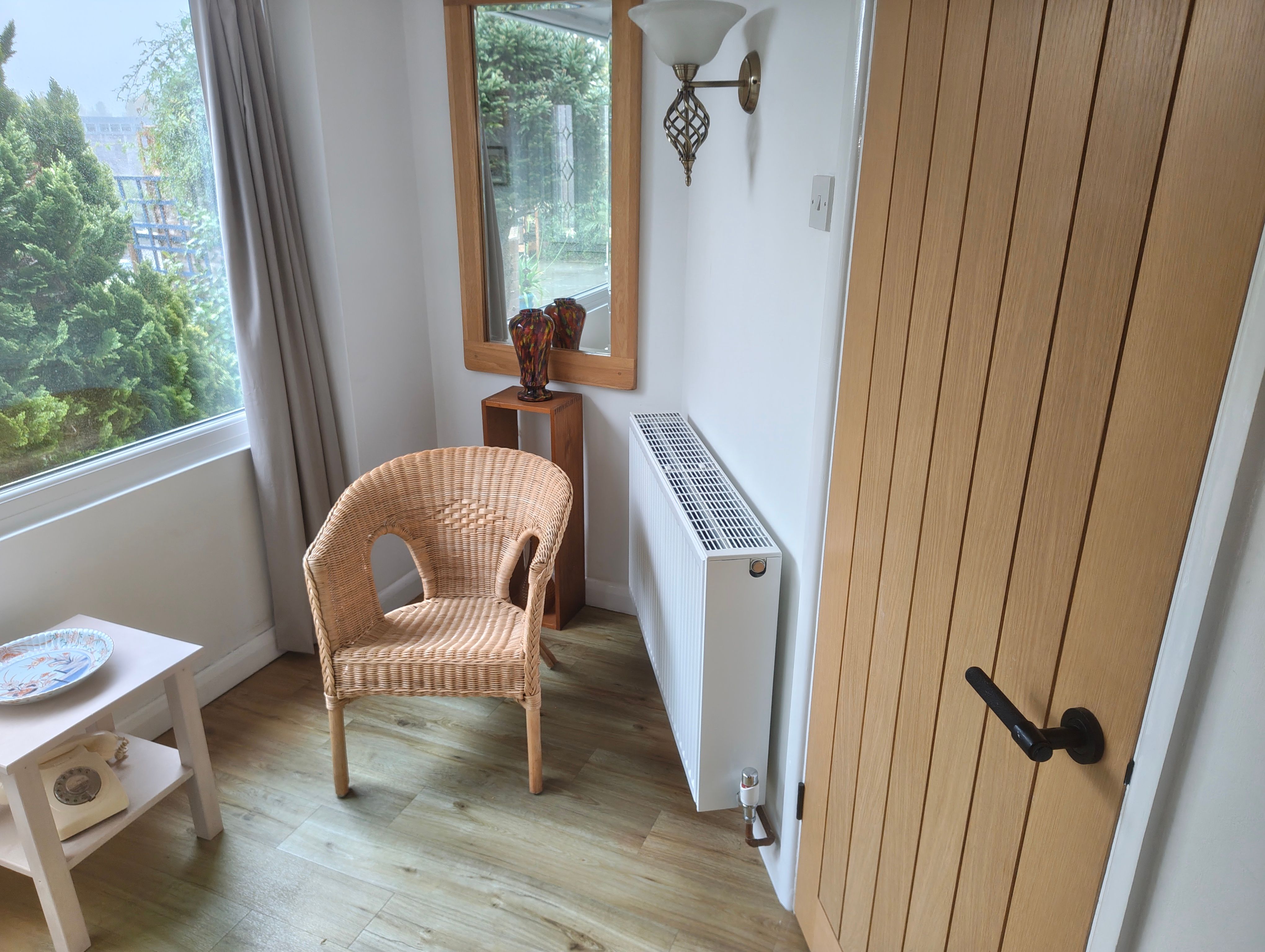
A simple HP system switches between running hot to heat the hot water tank (typically once a day) and running more cooly, to heat the house. Heated towel rails need to be hotter than the now cooler running radiators, and are better separately electrically powered.
Our experience
After one year, our experience in a 1960’s house with an HP, large hot-water tank, large radiators, solar panels and battery is almost entirely positive, despite our not-so-warm towel rails. In theory all HP can cool as well as heat – but sadly having cold water run through your radiators leads to all sorts of problems with damp. So, while an air-to-air HP can both heat and cool your house, an air-to-water HP can only cool an underfloor heating circuit or one for a separate fan-blown convector radiator. We did not know this and will have to use other methods for keeping cool in the summer. Don’t forget that insulation is good both for keeping heat in during the winter and keeping heat out during the summer.
The HP itself is installed outside, and the planning rules are now more relaxed as to where they can be placed. They are not silent. But besides avoiding putting them where the noise would reverberate or right next to where you or your neighbour sit on a patio, when properly installed/maintained it should not be a problem. The noise ours makes disappears in the general ambient noise of Rye town, though must add to it.
Installation
Getting an experienced installer helps, not just in designing the system to meet your and your home's needs, but in the setup of the controls for day-to-day running. Ask potential installers for how many HPs they have installed and ask for references from previous installations. We did not and wished we had. The installation disruption can be considerable, so consider doing other house renovation at the same time. Set-up is also more complicated than a typical boiler. Nonetheless, after some hours spent with the 60-page manual and several weeks of experiment, we are very pleased, perhaps even a little smug!
If you would like to see how things look and work, email me at ryenews10@gmail.com with subject line Heat Pump to arrange a visit.

