


Hidden beside the River Rother with its collection of 12 small fishing boats and behind the Town Salts lies a large blue building: Chapmans’ fish wholesalers, known to local people for the delightful fish bar in their car-park. Running out of the rain, I enter the shop and am immediately confronted with a large assortment of beautifully displayed fresh fish and a friendly smile. Much of the fish on sale is local, but the company also buy in items that are popular in the shop but not available locally, like salmon from a Scottish fish farm that does not use chemicals.
I have an appointment with Louise Chapman who, together with her husband Keith, run the business. We have spoken before; today is to explore two issues, changes that affect local fishermen and how the Chapman business is able to support them. Later, Adam the general manager who knows the local fishermen well, joins us.
Fishing on a one-man boat is an arduous and dangerous occupation, out for 12 hours alone, in most weathers, at erratic times of the day which change with the tides from day to day. Adam pointed out that some tides are too dangerous to risk; for example, during the last few days of October all boats would stay docked. Fishing as an occupation tends to run in families, and Louise was conscious that no younger members of the families have joined the boats in recent years; the oldest fisherman is 76 and the others are all getting older….so there is a concern for the future.
There have been other changes that have impacted the fishermen's livelihoods despite all the local boats being highly sustainable. Louise comments that there are no longer clear-cut seasons for particular species of fish and the catch quantity is much reduced; she attributes this to a possible change in sea water temperature. The reduction in the number of fish caught may also be linked to the Dutch and French factory ships which are reputed to stay out for a week or more at a time. If large nets are used by these boats, there is a danger that small immature fish will be trapped between large ones and that they will die before they can be returned to the sea, resulting in depleted stocks. It is feared that any further concessions made to the EU permitting large fishing boats to come closer to shore could undermine the livelihoods of local fisherman.
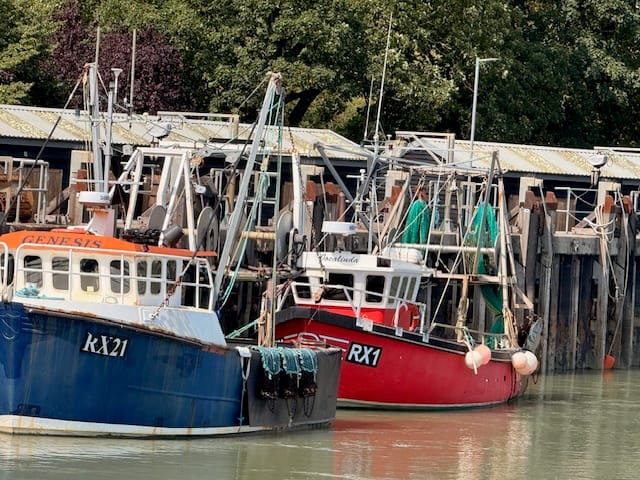
Louise said she is in contact with fisheries in Penzance where the arrival in large numbers of a species of octopus is causing concern because they live on crabs and shellfish, upsetting the food chain; will this change reach to Rye and beyond? Are there any known species of fish in British waters that eat octopus?
If all this were not bad enough, expenses have gone up massively for the local fishermen; Louise explained that it costs £300 for diesel for 12 hours at sea which must be set against the value of the haul. Although the boats last for very many years, they are required to be taken out of the water once a year for maintenance; another cost. All fishing boats have to carry equipment which logs and reports their location. This is a safety feature, but the fishermen dislike it because it reveals the location of fish stocks to others. As a rule, Louise said that the local boats work inshore out to a range of three, or exceptionally six miles. They generally catch the popular sea bass, skate, Dover sole, turbot and crabs. There is also one specialist lobster boat. The famous local scallops are safe! Conditions in Rye Bay are uniquely favourable according to Louise.
There is a symbiotic relationship between Chapman's and the local fishermen; the business buys all their catch, whatever it is. Excess is sold to Billingsgate Fish Market, for example Louise sold 'tons of whelks' through them to markets in the far east where they are appreciated. Anything that cannot be sold is given to the fishermen to put in crab and lobster pots, the smellier the better to attract crustations. There is a lot of paperwork for both the firm and the fishermen; Louise helps the men with it after their long days at sea. Both Adam and Louise stressed that the shop, boats and catch are monitored by MMO - Marine Management and by IFCA, the Inshore Fisheries and Conservation Authority whose representatives are authorised to board the boats to check the catch and measure the fish. They also check the landing statistics against each fisherman's records.


