


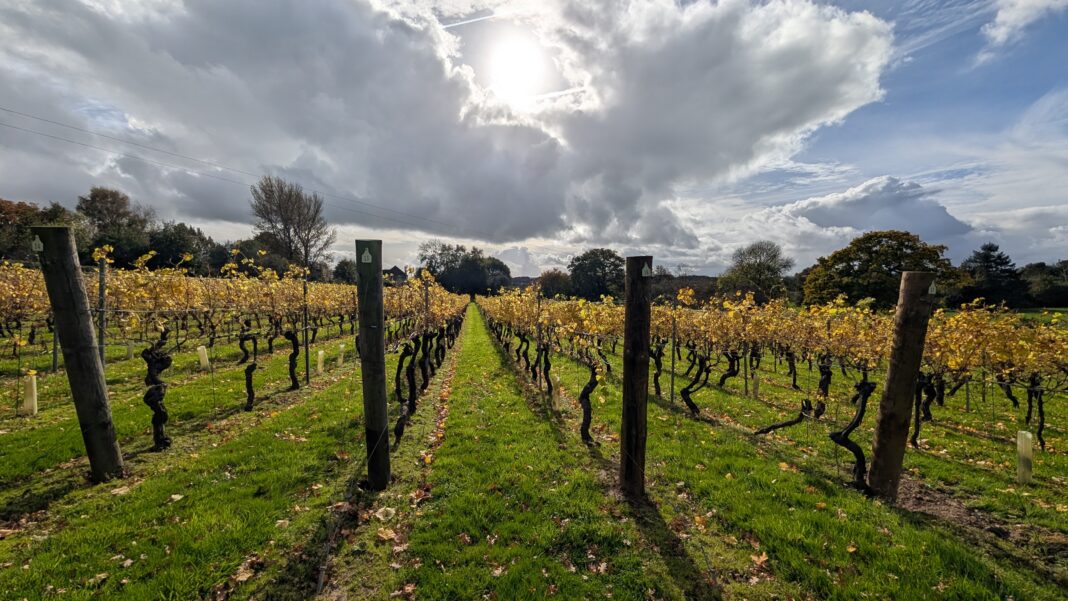
With Christmas and the New Year celebrations behind us, as we sit by the fire, dined and sated and with thoughts now turning to longer days, shorter nights and nature’s re-emergence, my thoughts return to the vineyard.
Not just any vineyard, I’m talking about Chapel Down, just outside Tenterden, and its various satellite vineyards around the area, as far apart as Peasmarsh and Maidstone.
Set among the rolling chalk soils of the North Downs, Chapel Down stands as Britain’s leading wine producer – a place where scale, craft, and Kentish character meet. With more than 950 acres under vine and a reputation for award-winning sparkling wines, the vineyard has become a standard bearer for English viticulture.
I joined the Chapel Down harvest team in September 2023 having had my curiosity aroused by an ad on the Recruitment SouthEast website earlier in the year – and have delighted in joining the harvest every September since.
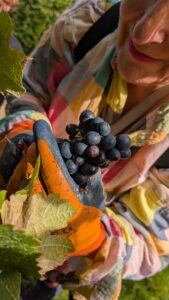
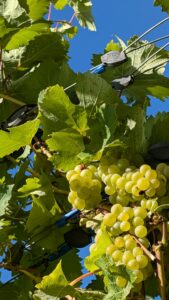
Being a freelance journalist, I have actively engaged in writing stories about people, places and events, preferring this to the humdrum and horror of the 24-hour news cycle. Therefore, to find myself standing in the middle of what I can only describe as heaven it was love at first sight for me, to have the honour and pleasure of standing amongst what to me looked like God’s garden. The lush greenery of the canopy (leaf cover) and the grapes themselves, smaller than eating grapes, nature’s work of art, sculpted by the loving care of those who tend the vines all year round.
Take the Chardonnay grapes for example, small green pearls in a bunch. Exquisite!
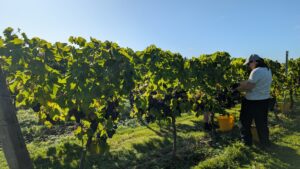
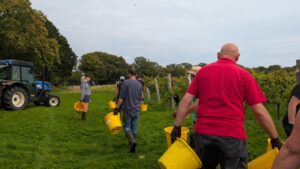
The sheer symmetry of the rows, wide enough apart to fit the tractor that pulls the trailer of huge crates into which, having filled our buckets, we toss them into the crates and when, replete with fruit, the crates are loaded, off they go to the winery.
The teams work in partners, one on one side of the vine and the other opposite, the
idea being no bunches get missed. We then snip each bunch into large buckets which are then collected by the “bucket runners”, hardy, nimble types, often of the younger variety. The teams themselves are composed of people from many different age groups and walks of life: students, housewives, pensioners, avid gardeners and people like me who, in an attempt to make retirement more interesting, are out and about busying ourselves with local council work, looking after grandchildren or, in my case, looking for interesting local interest stories – and the characters we meet on the way.
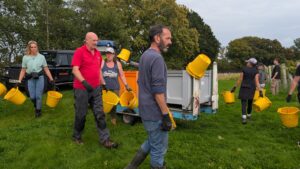
Being part of this fantastic group of people is, to me, something to look forward to each September when we meet again in the car park at Chapel Down at 8am ready to start the day. Come rain or shine, we all turn up, greeting old friends from the last time and, bucket and snips in hand, go among the vines for our yearly burst of energy and that buzz you get from just being among nature: red kites circling overhead, stepping aside to avoid small frogs from a nearby pond – and alpacas watching us curiously from a field nearby!

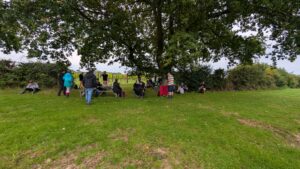
We have two breaks, a tea-break at 10am and lunch at 1pm during which, weather permitting, we surround a wooden table and benches to chat about the morning’s exploits, or reclining in the shade of the mighty oak trees or my personal favourite, laying under the vines and looking up at the sky through the leaves. It brings out the hippy in me!
However, right now, in the depths of winter, preparations are being made for this year’s harvest. The vines are in the process of being pruned.
Having undertaken this myself in the past elsewhere, one of the curious aspects – but it makes sense when you understand the reasoning behind it – is working with the sheep. Some vineyards have sheep among the vines in winter to crop the grass and to fertilise the soil. It’s quite amusing, to have these hardy, but rather timid, farm animals working alongside you!
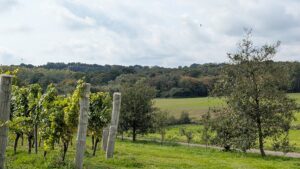
After the careful – and exacting – winter pruning, selecting the canes and choosing the buds that will shape the coming season – the vineyard moves into its spring rhythm with the quiet but essential job of bud rubbing, removing unwanted shoots so the vine can direct its energy into strong, productive growth. As the weeks warm, the team begins the cycle of canopy management: positioning shoots, tying in new growth, thinning leaves to improve airflow, and keeping disease pressure at bay.
Through early summer, the vines flower and set fruit, and the work becomes a balance of nurturing and restraint, ensuring each plant carries just the right amount of crop. By midsummer, the focus shifts to monitoring – walking the rows, checking bunch development, and taking regular samples to measure acidity, sugar levels, and phenolic ripeness. These tests continue into late summer as veraison (when the grapes start to change colour) begins and the fruits soften and change colour, giving the team a clear picture of how the season is unfolding. All of this steady, skilled work leads up to the moment just before harvest, when the vineyard holds its breath and the fruit reaches the perfect balance that defines the character of the year’s wine.
I look forward every year to the harvest now that I am living the metaphor – the “harvest season” of my life. It gives me purpose, joy – and much-needed REAL exercise!
Perks include being treated to seasonal discounts on wine and the company brings us together post-harvest for a fantastic lunch in the winery restaurant at Tenterden – and a free winery tour.
During my time on the harvest team at Chapel Down, I found that its success isn’t just rooted in terroir or technique, but in the quiet confidence of a landscape that knows exactly what it can offer. Walking the rows, talking with the team, and watching the light shift across the vines revealed a story far richer than statistics: a modern English vineyard shaped by tradition, ambition, and the unmistakable spirit of the Marsh.
What sets Chapel Down apart from other English vineyards is not only its size but its reach. Producing over two million bottles a year – more than any other winery in the country – it operates on a scale that allows it to compete confidently with established European houses while still championing the distinctiveness of English terroir. Its sparkling wines, in particular, have become a benchmark for the industry, consistently outperforming rivals in blind tastings and national awards. This reputation has earned Chapel Down a place at some of Britain’s most prestigious events, including Royal Ascot, where its wines are poured as a symbol of modern English excellence. In a landscape of boutique producers and rising regional stars, Chapel Down stands out not just for its acreage, but for its ability to represent the very best of English wine on the grandest stages.
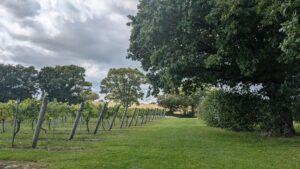
Chapel Down has 1,018 acres of vineyards locally of which 777 are fully productive, an increase of 30% productive vineyards since 2022. The 2025 yield in a report dated 23 October was expected to be 2,882 tonnes (2024: 1,852 tonnes) at an average yield of 3.7 tonnes per acre (2024: 2.5 tonnes per acre) – 15% higher than the historic 5-year average yield per tonne.
In a harvest update published by the company on MarketScreener.com the company
announced: “The summer of 2025 created optimal conditions for development of the vines resulting in ripe fruit flavours and natural acidity that will add a fresh, crisp backbone to our wines. As more of our vineyard estate becomes fully productive, Chapel Down is able to create a higher mix of Traditional Method sparkling wines which are the company’s core strategic focus.”
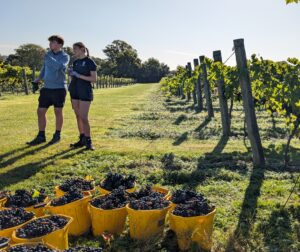
I strongly advise a visit to the winery at Tenterden and a walk around the vineyard in ANY season: just lap up the pure symmetry of not only the rows, but the planting of the trunks, also spaced with mathematical precision several feet apart in order that their cordons (the horizontal branches from which the canes sprout) have the room to produce abundant fruit.
Make sure you book yourself in for the wine-tasting and tour, details of which are on the Chapel Down website. The winery also has a restaurant and you can eat outside in the Summer!
https://chapeldown.com/blogs/news
I toast you with a glass of my favourite Bacchus – a teeny drop of which was picked by my own fair hands!
Your good health for 2026!
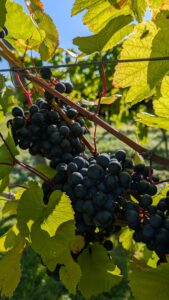
Image Credits: Kim Rye , Kin Rye .
How lovely Kim.Wish I lived nearer do I could help.
You have just painted the perfect picture of summer. Which during this cold weather is a welcome respite. It sounds amazing and will be on my bucket list to visit.
Great article Kim. I honestly had no idea of the scale of the vineyard and production at two million bottles a year! WOW…
Good to see the sheep being utilised too.
The more the merrier eh?
What a fabulous article and also happens to be one of my favourite times of the year, really enjoyed reading this.
Brilliant article Kim. Made me want to go to our wine rack and have a tipple or two, ok the whole bottle . Roll on the summer
Kim, a good reflection on an annual event for me! The peace of labouring in the vineyard the connection to creation. Each year is different, meeting new friends , all fascinating people each with their own stories make this so special. The Chapel Down team are respectful and inclusive which makes working for Jack The Vineyard Manager and our Harvest Manager an easy task! Cam is our recruiter (cam@recruitmentsoutheast.co.uk) and has spent time picking with us over the years so understandings all we are doing. Try it once, if you are able , you won’t regret it! It is hard work but the rewards and privilege of just being there are well worth the labour.