


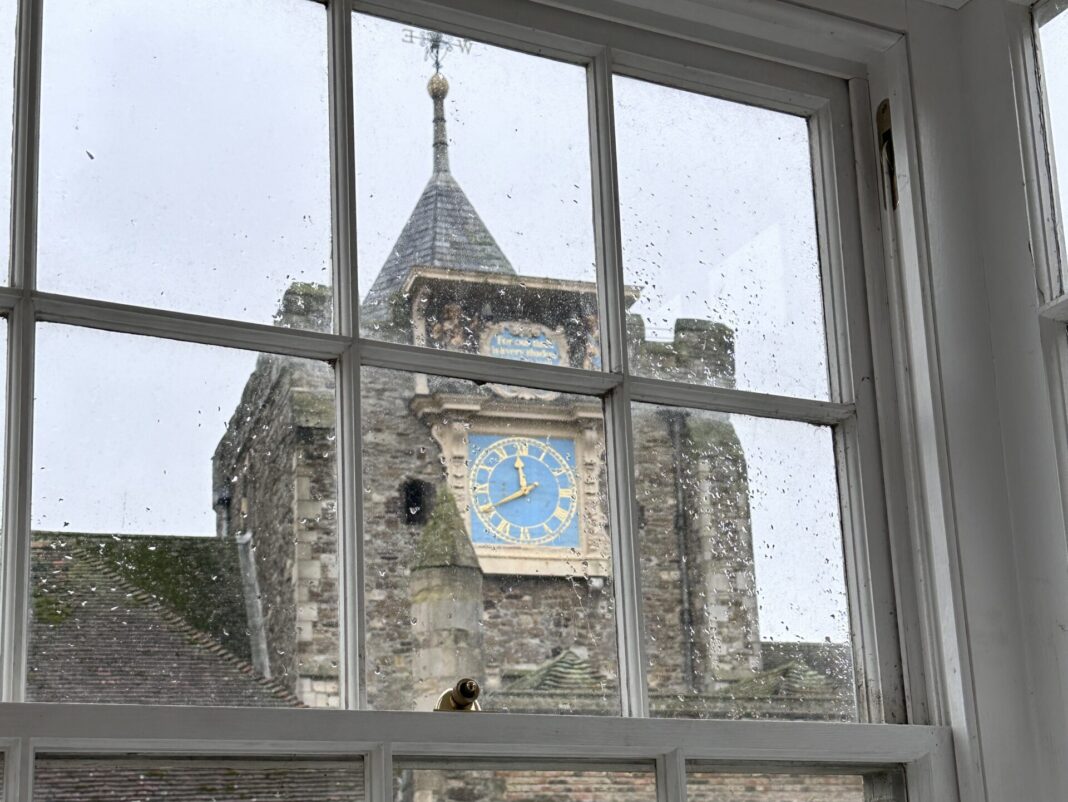
Each month we’ll be taking a look at what’s been happening in St Mary’s through the eyes of one of the churchwardens. It’s a very different take on life in the church, and this month it’s the fascinating history behind the church clock and the efforts made each week to keep it to time. Roy Abel invites you to join the churchwarden for a pint.
Well. Hello. Welcome to the churchwardens’ corner. Yes it is a bit dark here but it helps the atmosphere when I talk about the mysteries of St Mary’s, our church on the hill. Now if I can just heave out to get to the bar, I’m sure I won’t spill anyone’s pint. You’re not going to risk it? So kind! I’ll have whatever you’re having.
Churchwarden? Yes that’s me, attempting to assist with many aspects of church life: some like the fabric of the church, weathered, battered, burned and prayed under for nearly 900 years: others like the current jazz festival are very much of our time. Yes you’re right some folk used to say jazz was the ‘music of the devil’ but I feel certain it belongs to nothing worse than a minor goblin. You’re a fan? So sorry. Well come along to, well, the devil’s music in God’s House!
Now there’s a powerful tag!
Generally though there’s a different kind of rhythm you find in these old buildings: a slower one, which is why they are such peaceful places. In our case the church is presided over by our ancient turret clock that still tolls the quarters over the town. In fact originally it was designed for just that, striking the bells to regulate the working lives of labourers and tradesmen who needed no clockface. But that was before it came to Rye in 1560.
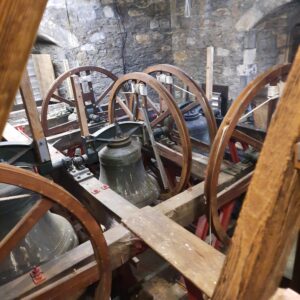
Yes, it had been whirring, turning and striking for maybe a couple of hundred years earlier but nobody knows where precisely, or what clever medieval engineer designed it and very likely fabricated it using blacksmithing skills of the finest order. If you are in the clock chamber on the hour you might be startled by a primitive propeller, mounted on the front, wheezing into life like a wingless flying machine. This is the flywheel driving the hammer for the tenor bell, one of the peal of eight, that strikes the hour from inside the tower while the quarters are brazenly struck by the gilded cherubs on the exterior.
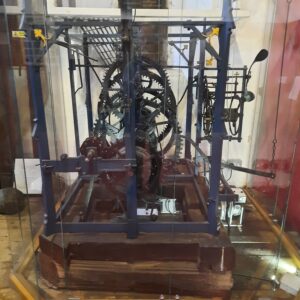
It’s far from digital and really quite erratic. Our clock gains about three minutes a week. It is reset every Friday by the verger Ben ‘Timelord’ Mason in time for the Sunday service starting at 10.30. If the clock strikes the half as rector Paul starts off, Ben glows with satisfaction. Not a simple thing though, because the clock is only 2 minutes fast on Friday and Ben has to allow for the clock to speed up at the weekend (like some of the clientele in here? Very droll!) How does he do it? Well as a fine horologist, he makes use of the “cobwebber”.
Excuse me while I take the merest sip at the thought of the church cobwebs – partly my
responsibility I’m afraid.
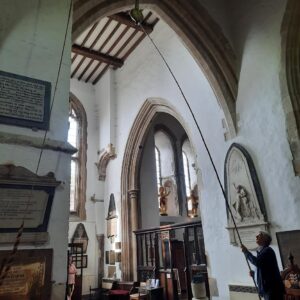
If you have never seen it, resting against one of the columns inside the main door at the top of Lion St, it is in fact a pair of 8 ft bamboo poles lashed together surmounted by a soft broom. This is used to gently sweep cobwebs from high up on the stained glass and stone traceries while the ‘webmaster’ teeters from the top of a 12 rung step ladder, but it is also the instrument used for fine tuning Rye time. Now, you should know that Rye time is a strange thing: hours can be lost in some existential void (often sited at the junctions of Cinque Ports street for unknown metaphysical reasons) but I feel it is down to the influence of the clock.
It runs on a giant pendulum that ticks away the seconds of our lives – except that each tick is more than two seconds from the nearest tock, thereby stretching our measure of time. So there’s an additional dimension-bending dynamic that happens once every week when Ben hefts the cobwebber towards the pendulum swaying monstrously from side to side inside the church entrance. He crouches, waiting for the right moment to press the broom-end gently against the sweeping metal ball: in effect halting time. Some say this creates a kind of Matrix moment where everything stops in the town. Traffic even grinds to a halt on South Undercliff, toilets stay shuttered and dark, no movement stirs the dust at the entrance to the police station.
What? You say you have observed these things, but you couldn’t if you were stopped in time! Perhaps you are unaffected. Be that as it may, 3 minutes later Ben gives the weighted disk a judicious heave and time starts again. It may be why everyone in Rye stays so young – particularly present company of course – and why Church Square has more nonagenarians than anywhere outside the Hunza valley. Though it’s true that our elders are fuelled on gin and fizz rather than dried apricots.
Oh no. So he really has called time. This time – but what time really? This is Rye after all and if you want to know if Ben used the cobwebber with precision, find out at 10.30 on a Sunday, or even 8.30 if you like the Jacobean style of service.
God bless you all, til we meet again.
Image Credits: Kt bruce , Roy Abel .
Our clock probably came from Hampton Court, and of the three clocks of its pattern (the others are in Salisbury and Wells Cathedrals) it is almost certainly the earliest, according to Keith Scobie-Youngs of Cumbria Clocks, who service it for us. Clock aficionados should look at his article (https://ahs.contentfiles.net/media/documents/Salisbury_Wells_and_Rye__great_clocks_revisited_IIqtQXb.pdf) explaining the subtle differences between the three, and you can obtain a leaflet about the clock from the shop in St Mary’s.
At the last service I was taught how to adjust the pendulum at the top but so far have not dared to risk my fingers getting caught! It was gaining about 5 minutes a week until the last adjustment, but to overdo it would cause a problem. If it runs fast we can stop it and wait, but if it runs slow then we would have to wait 12 hours. I am waiting for winter to see how much the temperature change affects it (the warmer it is, the longer the pendulum and the slower therefore it would be) but suspect an eighth turn of the adjustment screw might be about right!
In my 12 years looking after the clock, originally helping John Gurney, we have had only five mishaps. Two were due to power cuts, when the automatic rewinding of the driving weights failed and the cables unravelled and came off their pulleys; one when a frame wedge became dislodged, one when the Quarter Boys connectors broke, and one when a new CCTV cable wrapped itself round the shaft of the rod driving the hands catching on the balance arm and winding tighter and tighter until it could wind no more. But for a clock that’s nearly 450 years old that’s not a bad record.
With this reminder of the Rye Clock, it is also worth noting that in 2012/13 the Friends of St Mary’s arranged funding and managed the complete renovation of the Clock. This involved dismantling, removal to Cumbria, rebuilding with revised winding and the fitting of a protective glass case, at around £37,000.
The technical work by Cumbria Clocks provided an opportunity to reconsider the history of the clock and to review its documentation. Little new was established about the clock during the project except perhaps that some filed studs on one of wheels indicated that in the past ( perhaps the 1700s) there was a carillon which has long since been removed. An article was produced for Clocks Magazine in September 2015 and a pamphlet drafted, which is still available.
https://www.ryenews.org.uk/culture/time-restored-st-marys
Dr Anthony Kimber
Chair Friends of St Mary’s Rye
Years ago when I was involved in Rye Festival (there was only one Festival then!)
the indomitable Geoffrey Bateman would stop the clock for us. This avoided the
wheezing, turning & striking which could disrupt a poignant piece of music at an
inconvenient time, it also reassured the musicians that they would not be interrupted.
We still do, and get up the next morning 12 hours later to start it up again.
We had one eminent violinist a few years ago who said she didn’t need it stopping, but about three minutes into her recital she stopped playing and asked for the clock to be stopped as once she was aware of the faint click at every swing it was playing havoc with her own timing!
What an interesting article! Thank you Roy. I enjoy your writing style too. More please….
Many thanks Hilary. Very rewarding to receive positive feedback!
The theory that the mechanism dates back to 1388 is important – if true, this would make our clock not only the oldest working church clock in the country, but the second oldest church clock in the world. Only the clock at Parma Cathedral in Italy is older.
I believe I remember reading a report from a Horologist Society a while back, claiming it was made in about 1390.
Goodness- how wonderful! Shouldn’t we promote this more?