


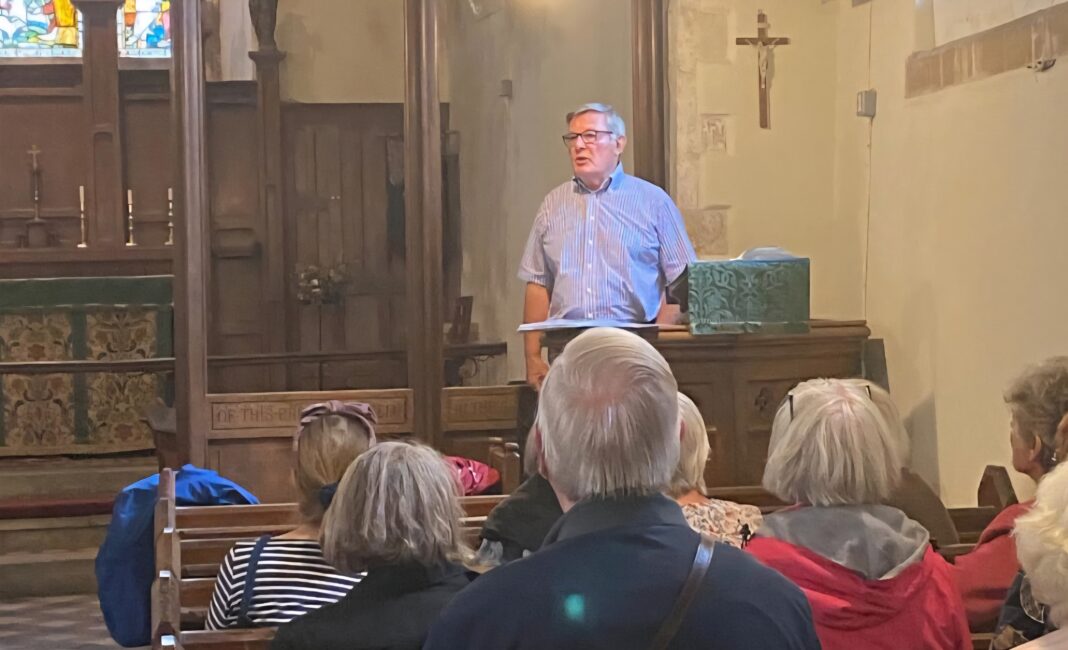
After almost a week of sun, we awoke to a grey day on Saturday, July 5. However the rain held off to allow thirty one Friends of St Mary’s to join Rye Community Transport at the Rye Station Approach for their annual summer outing to visit two churches and take tea on Romney Marsh.
With everyone on board, Pat Hughes had selected a “country route” to get to Burmarsh. This was a 45-minute run through the centre of the Marsh, taking in Ivychurch, Newchurch, and St Mary in the Marsh before arriving at Burmarsh.
Burmarsh in Kent is a very small marshland village which lies just inland from Dymchurch between the coast and the hills at Lympne. During Roman times the area was used to provide salt. Burmarsh can trace its history back to when it was given by the grandson of King Ethelwolf to St Augustine’s Priory at Canterbury in the 9th century. The village has for centuries been involved with sheep rearing and smuggling.
The small 12th century All Saints Church, reached by a footbridge over a stream, is mainly Norman, though the chancel may have been a Saxon chapel.
The Church of All Saints in Burmarsh was built in the mid-12th century, by monks from Canterbury after the arrival of William the Conqueror, possibly on the site of an earlier Saxon building. The tower has large strengthening buttresses, a common feature of church towers on the soft marsh ground. The door is very similar to the Norman doors in the south and west walls of the church at nearby Dymchurch, with the exception that here there is a gargoyle peering out of the top of the arch. There is another over the window above the west door, although much weathered. There is a Norman window in the north wall of the chancel.
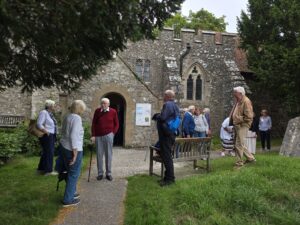
There is a fine royal arms on the south wall, from the time of George III. In 1876 the interior of the church was modernised by the Victorians and the old box pews, three-tier pulpit and sounding board were removed. A wooden reredos was installed at the end of the 19th century along with inscriptions on the chancel beams.
There are six bells – two medieval. A third medieval bell, carrying the royal arms of England and the foundry mark of the royal bell founder, stands damaged in the nave.
After Burmarsh, the party moved on to Dymchurch, which has a rich history also dating back to Roman times. The Church of St Peter and St Paul church is a classic Norman church built about 1150 and has remained virtually unchanged for nearly 700 years. In 1821 the population of Dymchurch increased resulting in the extension of the north aisle.
The nave was re-roofed giving the church its present lop-sided appearance. The 13th century font was once thrown out – possibly by Protestant dissenters- and then restored in the 15th century after being recovered from a ditch.
In the churchyard are a number of gravestones decorated with the skull and cross bones. Two tombstones in particular catch the eye. One is of Solomon Pepper, a character from the Doctor Syn stories, and the other is of Charles Keeley, a smuggler killed near the Ship Dymchurch by midshipman Richard Morgan who was himself killed by the Aldington smuggling gang in 1826 in Dover. All are buried in the churchyard.
Opposite the church is New Hall, rebuilt in 1575 to replace an earlier wooden structure, which was destroyed in a fire. This was the court room for the Romney Marsh area. The Jurats of New Hall imposed the Scot tax on residents to fund maintenance of the sea wall. Those outside the boundary were said to have got away “scot free”.
During the 17th and 18th centuries, smuggling was rife all along the south-east coast of England. The remote Romney Marsh and surrounding areas were amongst the busiest locations for illicit trade. This inspired Russell Thorndike to set his Doctor Syn smuggling novels in Dymchurch.
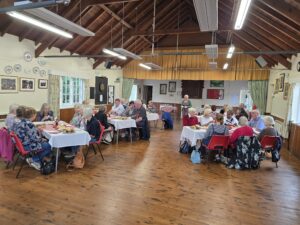
From Dymchurch the party headed from Stone-cum-Ebony, where the ladies of Stone were were waiting to provide a sumptuous tea in their fine Women’s Institute china.
After some “thank-yous” to Rye Community Transport, the ladies of Stone-cum-Ebony and Gill Harvey of the Friends, a well-fed party returned to Rye by the Military Road. Despite the dull weather, many enjoyed the trip and look forward to next year’s event.
Image Credits: Elizabeth Kimber , Anthony Kimber , Anthony KImber .
I would add many thanks to Anthony Kimber for all his research and for providing us with such interesting talks about the history of each church. It was a very enjoyable outing and as always the tea at Stone was amazing!