


Plans have been unveiled for the biggest shake-up in local government in the county in over fifty years. East Sussex County Council and Rother District Council would be abolished under the proposals, leading to fears about a lack of local representation.
The news comes in the same week Rye Town Council finished consultation on taking over some of the assets currently owned by Rother, including public toilets and car parks.
On Wednesday, September 10 the six main councils within East Sussex jointly published a draft version of a business case advocating for a “One East Sussex model” — in other words their replacement with a single new unitary authority based on the current county boundaries.
Each of the councils are due to consider this business case in the coming weeks, with cabinet members expected to decide whether to endorse its submission to the government or else to back an alternative proposal.
The draft business case reads: “The preferred ‘One East Sussex’ model of a single unitary authority for East Sussex offers the strongest platform for transformation, based on the existing district and borough council boundaries.
“It enables whole-system thinking and delivery, allowing for the integration of services such as housing, social care, education, and public health. This will lead to improved outcomes for residents, particularly in areas of high need, by reducing duplication, enabling earlier intervention, and supporting more strategic commissioning.
“While the financial modelling highlights a long-term structural deficit, it also shows that, when social care is excluded from consideration, the case for a single unitary becomes more compelling. The model delivers a positive return on investment, aligns with national policy, and positions East Sussex to play a leading role in regional growth and devolution.
According to the business case, the One East Sussex model would generate cumulative savings of £64m by 2032/33, with £25m of annual recurring savings.
Even with these savings, however, the business case warns the new council would still operate at a deficit unless action is taken to address an “ongoing social care funding shortfall”.
Without additional funding in this area, it argues, the new council would be on track to fully deplete its reserves. This would be due to a cumulative deficit of £5m in 2028/29, increasing to £226m by 2032/33 as well as an annual recurring structural budget deficit of £61m.
A consultation process also included a countywide survey held between May and June 2025, which gathered 5,500 responses.
While, the business case says, most respondents (nine out of 10) identified at least one benefit with the single unitary model, the survey also highlighted significant levels of concern around the loss of local representation.
Many respondents felt an East Sussex unitary would be too big, wouldn’t “understand their area well enough” or simply see their area “forgotten”. The business case notes how a two unitary model could dilute these problems, but also potentially carry a risk of smaller or more deprived areas becoming marginalised.
If a single unitary model is agreed by the government, the new council is currently expected to hold its first elections in 2027. It would then be expected to spend a year as a “shadow authority” alongside the county’s six existing councils, before replacing them entirely in 2028.
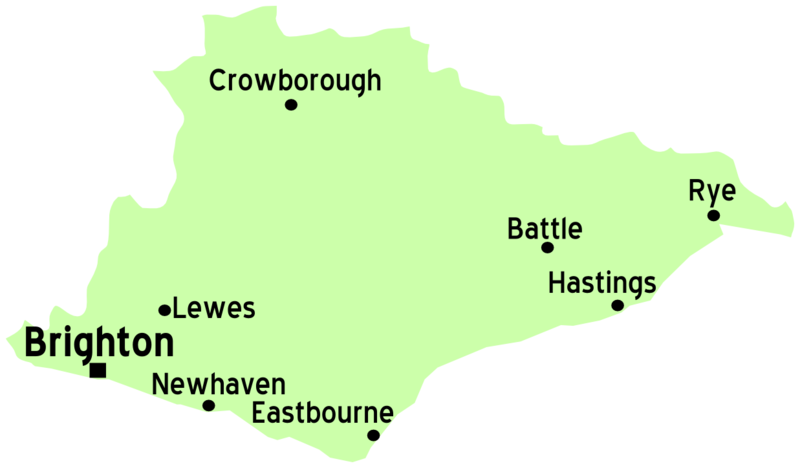
Image Credits: Wkimedia commons https://commons.wikimedia.org/wiki/File:East_Sussex_map.png cc https://creativecommons.org/licenses/by-sa/1.0/.
The above map says it all. Brighton, in larger type is meant to stand out, as it does, because almost certainly One East Sussex will be overshadowed and led by Brighton, with the proposed Mayor being based there.
The map also indicates the distance of Rye from the would be centre of power. I have written before that the distribution of finance is like ripples in a pond from where a pebble is thrown in, the further from the centre the less the effect.
Eastern Rother has always suffered from a lack of tax payer funding, anything from road improvements, to public transport or even finance to maintain the Landgate. There is no reason to imagine that situation will improve under One East Sussex, it is my view that there will be even less support available.
Rye Town Council, along with the local Parish councils are to be applauded for their intentions to take on extra responsibilities, which of necessity, will increase their financial outlay with a consequent increase in their precept. At the moment the precept grant is claimed by each town/parish council from their District Council, which itself obtains that money from the local council tax payers.
Unlike the higher echelons of local government there is no restriction on the amount of increase for councils that receive a precept, so extra responsibilities will inevitably mean higher council tax.
The figures quoted above of a cumulative deficit of £5m in 2028/29, increasing to a massive £226m by 2032/33, just four years later, as well as an annual recurring structural budget deficit of £61m, are not an indication of any kind of financial improvement brought about by merging the six local authorities into one large, unmanageable governing body. Quite the opposite.
One can only hope that our respective councils will have a change of approach, consider the views of their electors, and ditch the completely unfeasible idea of one authority governing the whole of East Sussex.
Local government should be kept local.
Keep it local.
What is it with Labour that they want to control so much of our lives? Rye is a freedom loving “island” within East Sussex. Let’s hope that a REFORM Govt will reverse this absurdity, back to where we are now.
It’s a Marxist thing. We will all end up, skint, tired, hungry and cold, governed by a central authority full of idealogues and nutters. But at least we will all be equal.
Whether Reform forms the next government or not,nobody could do any worse than the present labour government,who have promised the earth,and delivered nothing.
Labour controlled Brighton & Hove City Council are already on manoeuvres to expand their area of influence.
BHCC want to expand eastward, initially as far as taking over Newhaven and Kingston. Due to strong opposition that idea has been dropped, perhaps only for the time being. Their plans now extend to the communities of East Saltdean, Telescombe Cliffs, Peacehaven and Falmer, all currently controlled by Lewes District Council, which strongly opposes any eastward expansion by BHCC.
This is only an indication of things to come.
If I wanted to be governed by Brighton I would have bought a property in Brighton rather than Brede. I am confident that the council tax payers of Rother do not want their contributions sucked into the bottomless financial pit that is BHCC, which currently has a debt of £420 million.
There will be a public consultation on the whole Devolution plan in Spring next year with a final decision shortly after.
The whole idea of joining Sussex into one unitary authority is being rushed through with unseemly haste, the public consultation in a few months time will be our last chance to stop it, hopefully we will.
Like Rob, I find the above somewhat confusing, raising more questions than answers. First, I have an abiding concern that local government will no longer be ‘local’, and whilst I appreciate the economies of scale proposition, the facts and figures relate large cumulative budget deficits. I note also the remark about removing social care from the spreadsheet. But adult social care is 48% of ESCC’s current budget… With children included, it about three quarters. Where will that funding come from? Set against the national average, we have an older population and lower wages, so I’d certainly like to know a lot more about how we’re going to balance the books. I think right now the country, politically and economically, needs certainty, and the local govt. proposals don’t feel like it they provide it.
Guy raises an important point regarding the median wage in East Sussex being lower than the national average. What are local government, including our own town council and chamber of commerce doing to attract businesses that offer better paid jobs to people in the area? It is fair to say the heavy focus on tourism only benefits the few while offering low paid jobs to locals and pushing the tolerance of residents. This isn’t good enough, and it is feeding the undercurrent of discontent. Our talent and especially our young talent will not stay in the area if there are predominantly only low paid job opportunities. There should be a heavy focus on increasing the average wage across East Sussex. Sadly I do not see any real appetite or ambition for this.
Reform at any level is meaningless unless the Government solves local government funding. Since the Conservative government deliberately and consistently starved local government of funding turning everything into a competition, pitting council against council for any scrap of funding they deigned to offer, we are in crisis, and no reform will solve the problem. Solution, revalue council tax bands so that the values it uses are updated and those in bigger houses will pay more, which is the fairest way to raise money for local government.