


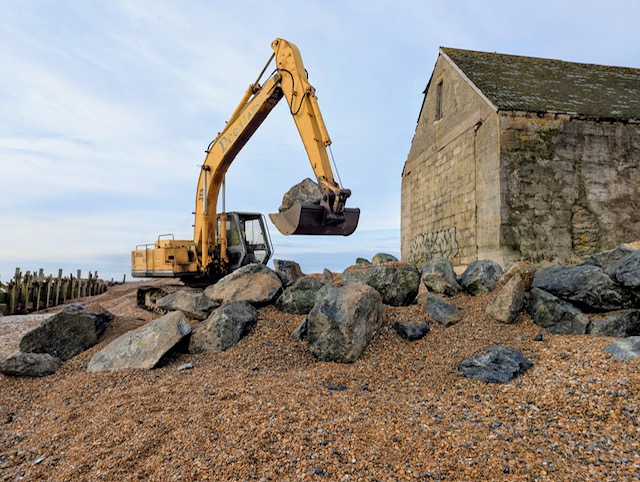
More rocks were added to the beach to protect the Mary Stanford Lifeboat House over the weekend of 13 and 14 December.
The work, again by volunteers acting independently of the agencies responsible for the coast, follows successful efforts to shore up the building in the face of early December’s high tides.
Five local people were so worried the Lifeboat House would collapse into the sea they took matters into their own hands and used farm equipment to move the rocks from an Environment Agency stockpile on the Rye Harbour Nature Reserve. They created a stone groyne that traps shingle in front of the building, preventing it’s foundations being exposed and washed away.
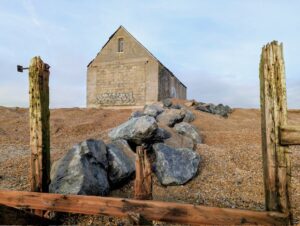
The latest work has seen the new groyne extended in length and height. A farm excavator has also moved more shingle into place to shield the building from the tide..
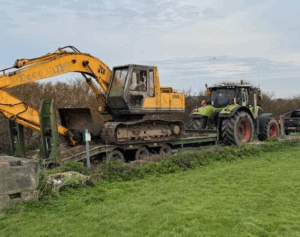
The volunteers were led by Icklesham farmer Philip Merricks. He said their work over the last month was urgently needed. “The most recent additional work that we carried out last weekend and during the beginning of this week ensures the lifeboat house is now well protected for the foreseeable future.”
The Mary Stanford Lifeboat House is a listed building maintained as a tribute to the 17 crew who died during a rescue in Rye Bay in 1928. For many years it has been protected by a secure bank of shingle held in place by wooden groynes which have fallen into disrepair.
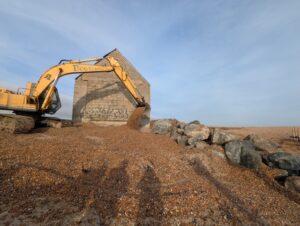
Image Credits: Philip Merricks .
Whilst I am sure those involved in the protection of the Mary Stanford Lifeboat House believe they are acting appropriately to preserve that building, do they have the necessary expertise to assess the impact of such action on the rest of the coastline? I assume any EA action requires extensive modelling and environmental impact assessments to ensure there are no unintended consequences. The very shingle they have been moving is could be there because of a planned EA intervention. I am not sure what sort of precedent such direct action from community leaders and local councillors sets to their community.
It’s about time something was done and good on these volunteers. It’s precisely the sort of bureaucratic “extensive modelling and environmental impact assessments” that stop anything useful getting done.
I support what they’ve done sometimes you just have to take matters into your own hands
Hello Judith .
I read your reponse to the intervention to protect the Mary Stanford Lifeboat house with interest .
I understand where you are coming and have respect for your view but the situation which had arisen was an imminent
threat as the forces of nature were primed to possibly destroy the building .
What perhaps is of more concern is that nobody had raised the alarm sufficiently about the condition of the foundations of this important building earlier on . Or maybe they have and either the EA have not taken notice or have said that it is not part of their remit .
The EA have been active with monitoring and taking action to protect the coastline for many years but clearly were not awake ( if indeed they should have been ) and it was therefore heartening that local people took it on themselves to rise to the occasion
and do the excellent and well executed work that they did .
Large stones were used from the Environment agency local stockpile together with shingle and a large stone groyne .
This usage of materials was nominal in the scheme of things
and would not affect anything elses adversely.
The Environment Agency does do some excellent work but like all big conglomerates is far from efficient and , much like manoeuvering a supertanker , it takes a very long time for them
to investigate , survey , have meetings and get authority to act .
In this case I believe that the correct action was taken and carried out so well .
The EA owned the building for what must have been over 50 years, they bought it off the RNLI as a garage/store after the disaster, the RNLI’s policy is if it’s of no use then get rid of it and spend the money elsewhere.
The EA must have thought that all their Christmases had come at once when they were approached by the organisation to list and preserve it.
What has happened is theat the shed has been taken off of the EA’s hands but they are still expected to throw money at it.
Does the EA have money to spare for this project and why has it taken the public the best side of a hundred years to suddenly wake up to it?
It’s always been there and as far as I’m aware there was no public interest in the building because of the superb monuments that already exist in the village and Winchelsea Church.
One must agree with Tony,let the building go, suddenly everyone is worried about it.But where were their concerns in the past knowing that the building has been in decline for years, and with the sea gradually getting closer.Use money raised to build a concrete lifeboat closer to the road,with 17 concrete oars with the names of these gallant men’s names on.
Thank you Philip Merricks and your team for saving this iconic building
A house on Fairlight was moved back. A nation wide appeal led by a famous person given the story would get support to preserve it.
Derek Bayntun
PS The old lifeboat house is a reminder of thoes brave men from ryeharbour