


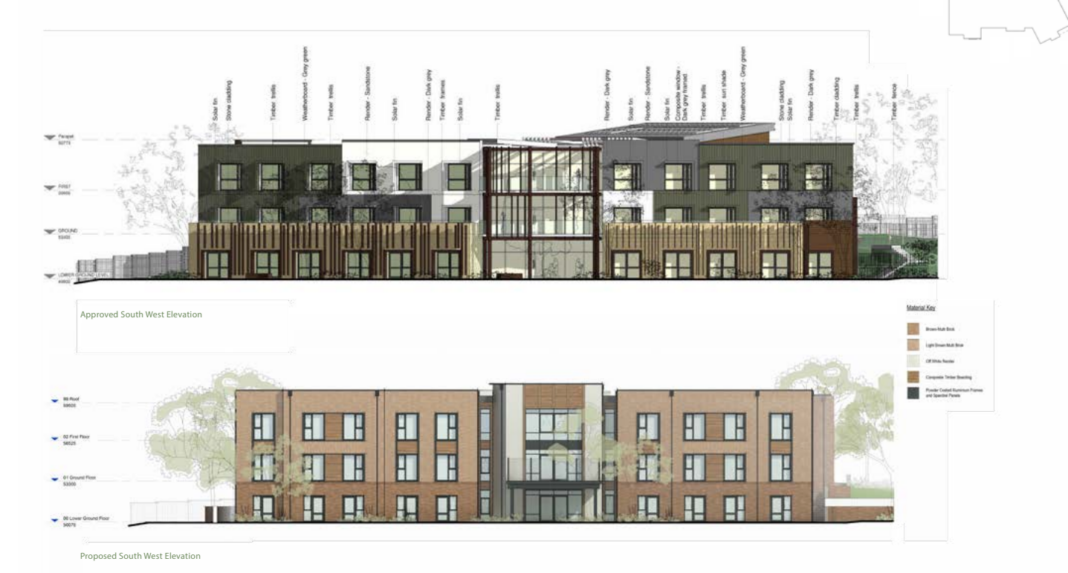
Developers of a large nursing home in Rye Memorial Hospital’s precinct have submitted a simplified building design to the planning authority in a bid to control costs and make the project “deliverable”.
The ambitious original design from 2017 for a dementia care home has given way to a smaller, less elaborate concept, without “landscape-blending” features in favour of a building more in keeping with the brown brick Hub on Rye Hill.
Although the care facility’s internal area will be reduced by 7%, the home will still accommodate 60 residents. Memorial Hospital’s chief executive Charlotte Kneer told Rye News: “The important thing for us is that the scope and purpose of the home will remain the same.”
Greensleeves Homes Trust and ZX Care Rye Ltd are identified as the planning applicants. ZX is known to be Mayfair based property developer Zephyr X, which says it’s assisting with the project’s funding and development. The firm has already developed several care homes and shares a business address and a number of staff and directors with care home operator EQ Care Group.
A spokesperson for Greensleeves confirmed Zephyr X will act as the nursing home’s developer and that Greensleeves will operate the facility. The Memorial Hospital is not financing the project.
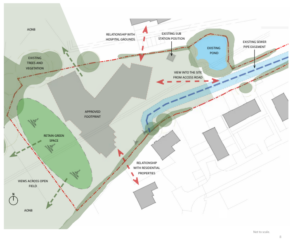
Given that the home will sit inside the High Weald National Landscape (AONB), grey-green weatherboard cladding and other features aimed at camouflaging the large three-storey building’s appearance formed a key part of the original planning application.
However, the developers currently reveal: “The material palette is significantly narrowed. The building is now primarily brick (brown and light-brown multi stock) with areas of off-white render and composite timber boarding.”
Owing to environmental considerations, it’s possible that RDC may consider the building’s facade is not in keeping with the local landscape character, and the council might impose conditions to ensure the building sits less conspicuously in the countryside.
According to Greensleeves, “a combination of site constraints and complex design” had prevented it from progressing with the original project, estimated to cost £8m in 2017.
Rather than the hammerhead shape initially planned, the proposal is now for more of an L-shaped building. At 3,216 sq m, the internal area will be 7% smaller and there will be 25 parking spaces instead of 30.
At least 15 of the 60 places at the nursing home will be reserved as “community beds” for local residents.
According to care home marketplace Lottie, the average price for private nursing dementia care in southeast England is currently £1,699 a week.
Details and images of the new Rye nursing home design can be viewed by searching for planning application RR/2025/1013/P on Rother District Council’s website.
Image Credits: ZephyrX / Harris Irwin , ZephyrX/Harris Irwin .
It’s great news that there will be a nursing home in Rye and appreciate that dementia care in the area is paramount but hadn’t realised it was solely for dementia care?
My understanding is that it is designed to be a ‘new nursing care home with specialist care’, the specialist care in question mainly being dementia-related. However, I imagine its use might include looking after people with other specialist care or ‘extra care’ needs. You would need to contact Greensleeves or Memorial Hospital to ask them to clarify this.
It is very good news about the possibility of a nursing home here in Rye, and I’m happy to share this with you, we currently pay self-funding fee of £1,783.10 per week or the average monthly fee of £7,747.99 per month!!! This is for a family member late stages Alzheimer’s Dementia, an awful illness. Nursing care is very, very expensive, if you savings or property equal to or greater than £23,250 you will not get any help from local authority or the government. You may qualify for NHS Funded Nursing Care (FNC) £256.06 per week paid direct to the nursing home, this FNC payment is not deducted from the monthly fee!!
So yes, self-funding nursing care is very expensive!!
Garry’s point is important to keep in mind when considering the development of local care facilities. If the proposed 15 “community beds” are intended for individuals who can self-fund their care, then we must acknowledge that this only serves a relatively small segment of the local population. Many will fall below the savings threshold at which local authority funding becomes available, and at that point, they may be expected to move to a more affordable provider—since council-funded rates are typically much lower than those quoted for self-funded placements.
If continuity of care in a single setting is important to the individual and their family, early planning and collaboration with the relevant local authority is essential. Without this, transitions between providers can be disruptive, distressing and damaging.
An alternative model is Extra Care housing. This approach, when implemented properly, supports people with varying levels of need to live independently in their own homes, with care and support available as required. It helps prevent, reduce, and delay the need for formal residential care, and aligns more closely with the values of independence and dignity that many older residents and their families seek.
While care homes remain a vital part of the care landscape, it’s important that we also explore and invest in alternative models that offer flexibility, choice, and long-term sustainability.
A comprehensive review published in Social Policy and Society underscored the benefits of Extra Care housing, noting that extra care housing can support people with early-stage dementia, reduce reliance on hospital admissions, and foster a more enabling and homely environment.
Here’s the thing as I see it. The new nursing home is on the Memorial Hospital land close to St Bartholomew’s Court Independent Living home which I believe has units used as Council Housing where you pay for extra care to remain independent. Wouldn’t it make sense for the new development to include some spaces for people from there who need more than independence? ie when they need long term nursing?
Thinking about it, it’s not necessarily appropriate to mix dementia care with other care!!! I was hoping that the new nursing home would take the people from St Barts.
I hope that the interior design of this new building will not look like a hospital setting as so many care homes do. There is quite a bit of research that shows, even for people at advanced stages of dementia, the opportunity to live in aesthetically pleasing environments that allow access to outdoor space, helps to improve the quality of life and wellbeing of people living with dementia and can also reduce disruptive behaviour. A 2023 BBC report highlights what good care looks like: https://www.bbc.co.uk/news/uk-scotland-south-scotland-64648948?app-referrer=deep-link. A free online publication from the University of Stirling Dementia Centre on this topic is a useful resource: https://www.emerald.com/books/oa-monograph/15535/Designing-Environments-for-People-with-DementiaA