


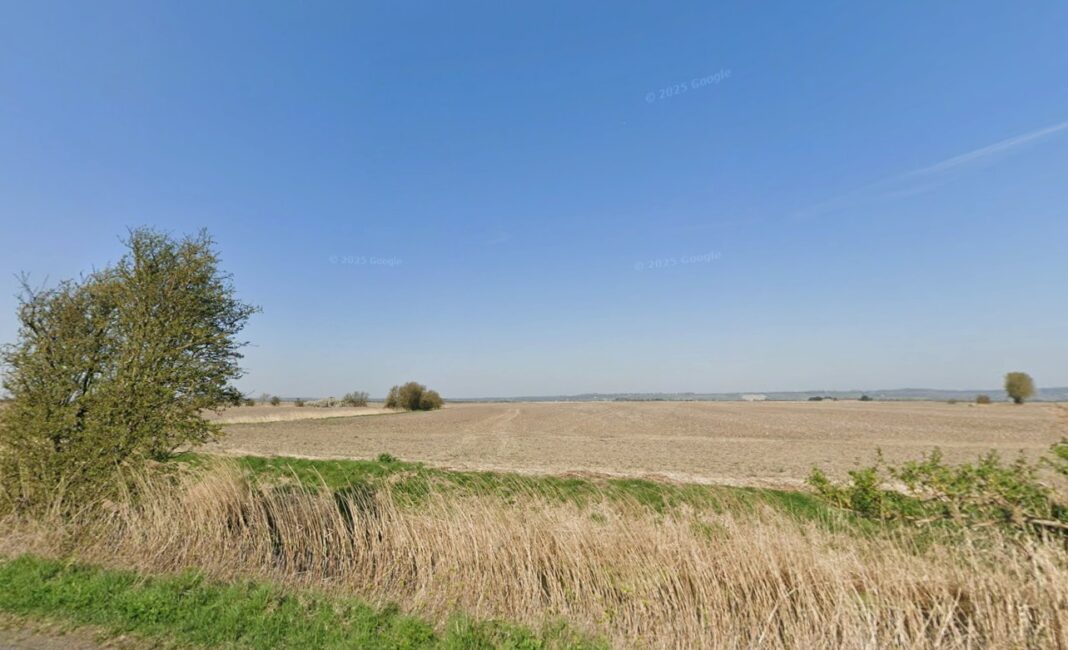
Controversial plans for a solar farm the size of 55 football pitches on Romney Marsh have been given the go ahead. The new site at St Mary in the Marsh will be the smallest in the latest generation of huge solar farms planned for the Marsh – including one near Camber.
Energy firm Enviromena was granted permission to build the facility on land off St Mary’s Road, opposite Marten Farm. Covering 40 hectares, the site is currently used to grow crops, including a “very healthy” winter wheat harvest, opponents told councillors.
The decision was made at a packed meeting of Folkestone & Hythe District Council’s (FHDC) planning committee on Tuesday 20 January, where officers had recommended approval.
The public gallery was filled with members of campaign group Hands Off Our Marsh (HOOM), which was set up to oppose the growing number of solar farm proposals across the area.
Speaking against the plans, HOOM representative Amanda Farrant said: “We’re not against renewable energy, we support it in the right places. This proposed scheme is the wrong project in the wrong place.”
She also warned the development could increase the risk of flooding on the low-lying marshland.
As with many solar schemes, Enviromena says the development will be temporary, with panels removed after 40 years. During that time, the land would remain in agricultural use for sheep grazing.
Councillor Colin Woollard of Newchurch Parish Council told the meeting that residents and councillors are “unanimous in opposition” to this scheme and three other proposed solar farms on the Romney Marsh.
He argued the parish would see no direct benefit from the energy generated, adding, “However, our parish will have to live with the disruption of visual amenity for 40 years – and the disruption and damage that large amounts of construction traffic will inevitably cause to the road network.”
District and county councillor David Wimble (Reform UK) also spoke out against the plans, saying, “Romney Marsh is not an industrial site – it’s a historic, rural agricultural landscape. Forty years of panels, fencing, substations and access tracks is not temporary in planning terms.”
In planning documents submitted to FHDC, Enviromena said the solar farm would generate enough renewable electricity to power about 10,600 homes each year.
The Romney Marsh has become an increasingly attractive location for solar developers due to its flat, open landscape and lack of trees. Renewable energy schemes are a national planning priority, with councils encouraged to approve projects where possible.
Addressing concerns, Steven Bainbridge, speaking on behalf of Enviromena, told councillors, “When we refer to temporary development, we mean it’s reversible in planning terms. It’s not prime agricultural land. The soil is not lost and can remain in pastoral use having rested for 40 years.”
Environmena first lodged its application in March last year and more than 80 objections were submitted by members of the public ahead of the meeting. However, councillors narrowly voted to approve the plans by eight votes to four.
After the decision, Enviromena’s chief development officer Mark Harding said, “We’re pleased the planning committee recognised the project’s merits, and we’re proud to be bringing forward something that strengthens the local environment and delivers long-term benefits for the community.”
A spokesperson for HOOM said the approval “sets a dangerous precedent” and warned the Romney Marsh risked becoming an “industrial energy zone” at the expense of food security, flood safety and its historic character.
Elsewhere on Romney Marsh, EDF and PS Renewables have put forward proposals for six pieces of land around Lydd with the biggest to the north of Jury’s Gap at Camber. The project is considered a Nationally Significant Infrastructure Project (NSIP) which will be decided by the Secretary of State for Energy Security and Net Zero rather than go through the local planning process.
Also being proposed: the South Kent Energy Park surrounding the village of Old Romney and the Shepway Energy Park near Newchurch.
Image Credits: Google .
In these very uncertain times food security must be paramount. Romney Marsh is Grade 1 land. How ludicrously short sighted to allow it to be taken out of production.
The world has genuinely gone mad.
Absolute disgrace that these projects should get approval on this land. The entire idea of these facilities is fake anyway as the on going costs to the environment and loss of food of food production is only covered by huge grants from central government which in turn is paid for by our tax.
It’s a brilliant way for large international energy companies to make vast sums of money out of a failed and useless energy production system to the costs and desires of most of the residents of the area.
Keep on fighting this and do not allow it to happen, it will be a tragedy for the Marsh and the land will be ruined for ever as once laid down on the ground these monsters (all made in China at great environmental costs) will not be removed and probably replaced in the future. It’s about time the planning department actually worked for the interests of local communities and not at the behest of greedy profiteers.
Couple of points on this. Yes using grade 1 farmland for solar is contentious. But it is entirely possible to combine food production – including sheep – with solar installations. Agri/voltaics is an actual thing. Second, the landowner presumably sees greater profit in solar than in ag. Would i be correct in assuming the owner is a farmer? Third, solar is hugely effective and all the evidence shows that. Fourth, it’s not paid for by taxes but by energy bills. And they will reduce the more self sufficient we are in energy. Fifth, we only produce 60% of our own food because we have not innovated enough. Sorry that was 5 points not 2.
Great post.
I agree with most of the above it’s madness when we need greater food security
My farm in Guestling is covered in solar panels it’s called grass and converts the sun into highly nutritious beef the same as many farms around Rye that are on marginal land. The best land should be producing the arable crops we need
The largest shareholder of Enviromena appears to be Masdar of Abu Dhabi and of course EDF is French owned, meaning that ongoing profits from these solar ventures will exit the UK, just like much of our privatised water company profits do. It’s ridiculous that we do not insist that such enterprises benefit Britain financially. The points about food security and the adverse impact on the landscape of vast solar arrays are valid. If I were living in Lydd, I’d be appalled at the prospect of my town being ringed by solar farms, as is currently planned. In general I support renewables, but believe the solar array sites need to be better chosen: use poor quality sheep-grazing land rather than arable fields, for example. That said, it’s counter-intuitive to install vast solar arrays in the over-populated SE of England, where space is at a premium. Solar panels are better placed on houses and commercial premises rather than open countryside and arable land. Wind turbines almost certainly offer a better solution on Romney Marsh. The reasons that the UK produces only 60% of its food are many and varied; lack of innovation is but one of them. Sadly it’s now widely accepted that beef production is a really ineffective way in environmental and economic terms to produce food. In passing, I understand that Mr Broadbent has been a non-executive director of several renewable energy companies.
So how about Brits invest in all these things instead of forever complaining about foreigners doing it and succeeding with their projects?
Ed Warner makes some interesting points here – and yes, it is a subject for good debate. The concept of solar on roofs is well made – just look at the vast roof spaces of the warehouses by the QEII bridge for starters. And I agree – wind turbines would be a better solution for Romney Marsh, while poorer quality land would be more appropriate for solar. I guess it was a question of ROI? I am also totally on board with the point about beef. Not entirely sure what the relevance of my past career is though. Seems to me we have more in common than not.
In France, and no doubt other places, solar panels are often installed over supermarket car parks, providing electricity from already developed space and providing shade and shelter for the drivers. Why not here?
I agree the point about industrial roofs – an obvious measure.