


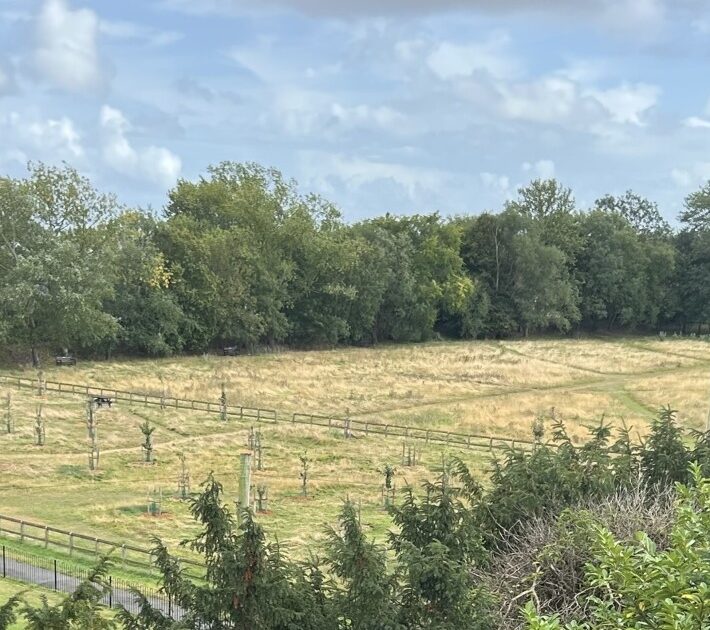
Over the summer I prepared a report on the future of the Iron Salts, Rye’s much-loved but often underappreciated green space. My aim was simple: to open up a discussion, to listen, and to seek support from those who care deeply about how we manage this important piece of public land.
I am grateful to Rye Town Council for allowing me to present the report and answer questions at a recent meeting. The discussion there, together with ongoing conversations with local conservationists, has helped shape a clear way forward.
A balanced approach
The consensus is that we need to strike a balance: creating swathes of wildflower meadow that support biodiversity and pollinators, while also retaining open, mown areas where people can enjoy walking, playing, and events. This balance will ensure that the Iron Salts is both a haven for nature and a welcoming space for residents and visitors.
Practical next steps
Rother District Council has responded very positively to the report. Importantly, they have agreed that after the planned annual cut later this month, the cuttings will be collected. This is not normally done, but it is a crucial step that will make it far more likely for wildflower seeds to establish successfully. On the advice of conservationists, this practice will need to be repeated after subsequent cuts, and in time this responsibility will fall more into local hands.
We are also exploring whether these cuttings could be put to good use in compost heaps managed by Graham Ellis, an excellent local green business leader and director of Community Compost Solutions and the Rye Community Orchards.
Community support
This project has already attracted generous local backing. The first (and very fittingly, “seed”) funding has come from Dominic Manning of Manning Wistow Architects, whose passion for climate and nature is well known in our town. This contribution, along with the support from local conservationists and landowners helping with mowing and maintaining the Iron Salts along with other partners, will help cover the modest costs of seed and ground preparation.
A process, not an event
It is important to stress that this is not a quick fix. Establishing wildflower areas on the fertile, alkaline soils of the Salts will take time and care. This is a process, not a one-off action, and it will take more than a year before the results are fully visible. What we are beginning now is a journey that will steadily improve the Iron Salts, creating a space that is richer in biodiversity, more attractive, and more flexible for community use.
Looking ahead
Rye deserves public spaces that bring together the best of both worlds: nature thriving alongside people enjoying the outdoors. The Iron Salts has the potential to be just that — and with the backing of our councils, local businesses, and community leaders, I am confident that this project will deliver real benefits for Rye.
Image Credits: Simon McGurk .
I applaud this effort to manage the Salts better. I personally have no problem with long grass, but I sympathize with the point made at the last Town Council meeting that the Salts were given to the town for recreation purposes. Developments at Mason’s Field by Tilling Green have shown that it’s perfectly possible to share space for humans with space for wildlife to flourish.
But when a recreational space is restored, could some plans be made to encourage use of it for recreation of humans and not just dogs? I know from many anecdotes and historical Rye documents that the Salts used to be far better used than they are now. How about a brainstorming session to gather ideas?
The Iron Salts !! Never heard that one before.. sounds funky…
Always presumed it was The “Town ” Salts .
I totally agree with you Darren this field has always been known by most Ryers as being part of The Rye Town Salts “The field next to the Iron Works” that I worked in during the 1960’s.
I’ve read all that and still have no idea what you’re going to, what percentage is going to be swathes of flowering meadows and how much will be left for the kids to play on.
Jane Steens reference to Mason Fields being a good example of humans sharing their space with wildlife.
Some of us can remember when there were sheep on that field, that was before it was left to estate as a recreation area and the was before it also got hijacked for conservation.
It’s not as though we lived in a concrete urban jungle the town is surrounded on four sides by country side.
As for the iron salts, my grand mother lived on Fish Market Road, I grew up playing on the town salts and never heard it referred to as the iron salts much the same as we never had a Rye castle or a citadel for that matter.
Why are people so keen to change everything and looked surprised when we refer to “us and them”?
As a point of interest, do we know when and how the name “The Citadel” came into use? When I first became Town Crier, 10 years ago, the name was already in fairly common use, and the Heritage Centre (under previous management) was offering ‘tours of the Citadel.’ I had always assumed it was the traditional name for the area within the walls, and have only recently discovered it’s a ‘new’ name! I am guilty of using the phrase to tourists…will try to refrain in future!
(PS – not sure if I count as an ‘incomer’ or not – one of my ancestors was also Town Crier of Rye in the 1720’s!)
The Councillors really need to show real vision on this sadly neglected old town salts, it would make an ideal park,and I’m sure grants and sponsorship could give Rye a park to be proud of just like Hastings and Bexhill have, and a legacy for the future of locals and visitors alike.
Councillor Simon mc Gurk
Is there any reason why you have called rye town salts
iron salts.
Let’s see the detail Si. Just because a space is underused for its intended purpose doesn’t necessarily mean it should be changed, perhaps the initiative should be directed at why it’s underused and what can be done to rectify the situation. Maybe the partial rewilding is the answer but we can’t give a fair view without the detail
As I say in the report, this is a journey to improve the Salts so there is space for recreation as well as encouraging climate friendly areas too. I’m confident most residents will see it as an improvement on the current state.
For those wondering, I used the term Iron Salts because I have heard that term used by several older Rye residents including one who used to play hockey there when they were younger. Town Salts, Iron Salts, we all know what I’m on about but what do folks prefer? (I admit Iron Salts does sound a bit Game of Thrones, I might have been swayed by the added drama!).
In over seventy years on this planet I have never before heard the term “Iron Salts” in connection with the recognised term “The Salts” in Rye. I had assumed that the Iron Salts must be somewhere quite different.
I have for sometime thought that there was a group of people living in or around the town (probably incomers) who want to change its culture. They may have ancient history on their side, but residents, often with their own multigenerational connections to Rye, want to retain their own family-built culture. It that way social history develops, to be interpreted by future generations.
Disgusting dig at so called incomers.
I suppose I could be called an ‘incomer’ but I’ve been here over 50 years & my children grew up here.
I’ve been involved in many organisations over those years & many events that took place on The Salts – Carnival, Medieval Festival &c. It was always known as just The Salts; they were there long before the Iron Works!
I wasn’t suggesting one had to have been conceived in the town in order to qualify! (Although it may have read that way.)
It would be interesting to know the name of the hockey player, to confirm how they came up with the IronSalts name, or can si McGurk enlighten us, because many who have lived in the town for decades have never heard it called by that name.
Well I was born in Fernbank Maternity hospital on Old London Road, Hastings. Got to Rye when I was a day old (could’ve been two. I can’ remember that far back). So I’m claiming dual nationality, Rye and Hastings Old town.
Ask a Rye fisherman (or an Old Town one) where not so long ago they would stretch out their gear/nets for repair. And the answer would be ‘the Salts’
For goodness sake. Everyone knows which Salts Cllr Simon Mcgurk means! Stop being facetious. You have all been whinging about ‘the powers that be’ not doing anything about it and it looking a mess and the ‘old Ryers’ not being listened to.
He is quite clearly and carefully trying to put forward a plan whilst keeping you all informed. I don’t know him but i am sure constructive criticism will be received well. Sitting behind your computer/phone keyboard and whinging about the same things over and over is just not helpful to anyone in any situation, ever!
Well no, I didn’t know where he was referring to and I used to work there on the fishing boats and lived in Landgate Square, amongst other places in Rye. I vaguely remember the Iron works (and Hockey being played there) but they didn’t dump any waste Iron slag/salts there. The “new” name is therefore inaccurate and void.
I imagine ‘Citadel’ was adopted by Estate Agents initially to delineate between the central part of the town on the hill and the hoy polloy below. Need something to justify the bonkers house prices in this exclusive area.
And since when is a poster the arbiter of comment content? I thought that was the editors job?
Being facetious adds just a little colour to the article. It might help if more ‘facetious’ comments were posted. Makes for more interesting reading than a lecture on ‘Old Ryers’ and whinging. That aside anything any politico says is as clear as mud, simply because there is always a hidden agenda.
So much of this debate distracts from a well directed attempt to balance recreation and nature in the management of green space.