


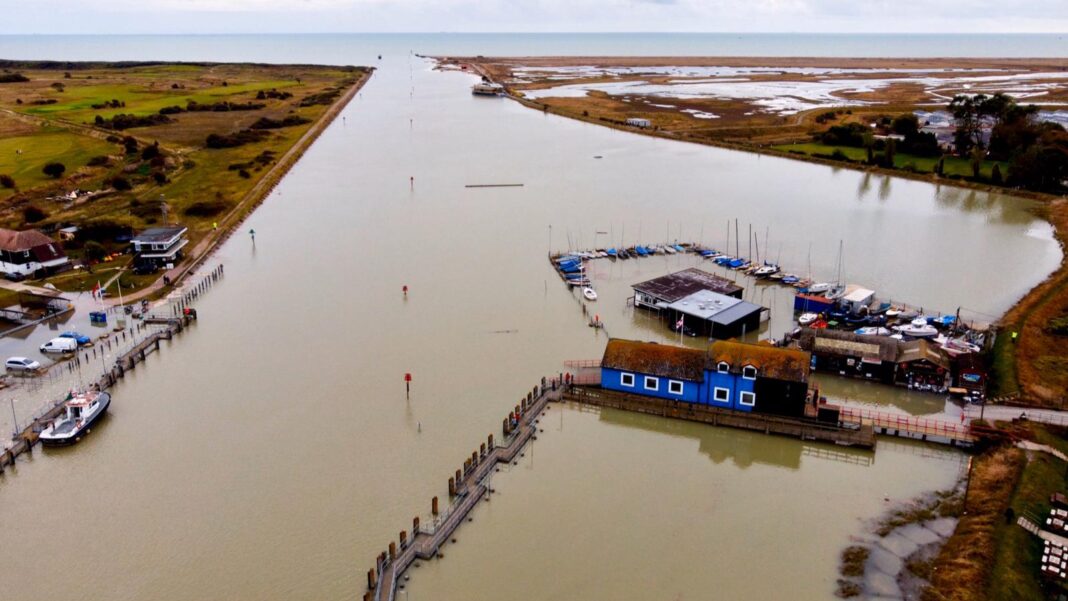
Sea levels are rising due to climate change and over a thousand homes in Rye are dependent on flood defences designed to protect the town from the sort of tidal surge last seen in December 2013.
Anthony Kimber considers the outcome of the 30th Conference of the Parties (COP30) to the United Nations Framework Convention on Climate Change. The COP is the periodic meeting to allow all countries, under the UN banner, to assess progress in combating climate change and negotiate new agreements.
What does it mean for Rye?
Is there global warming?
The NOAA National Center for Environmental Information, indicates that 2024 was the warmest year since global records began in 1850. The global average surface temperature was 1.29 °C above the 20th-century average (13.9 °C) and 1.46°C above the pre-industrial average (13.7 °C), which NOAA defines as the period from 1850-1900.
This warming intensifies the global water cycle, leading to more frequent and severe extreme weather events such as heatwaves, droughts and heavy rainfall. We see the more frequent rainfall events here in Rye, which cause ponding of surface water and more seriously, the type of landslips seen above Military Road. Global warming also causes sea-level rise and ocean acidification; both have serious impacts on ecosystems and human communities worldwide.
The COP Process
As if to underscore the seriousness of climate change, the number of attendees at COP is always significant. COP30 (November 2025) in Brazil, saw around 56,000 attendees, which did not break the record held by COP28 in Dubai, where over 83,000 attended. Both have been a huge gathering of delegates from governments, representatives from civil society, business, Indigenous Peoples, and other observer organisations. Such large gatherings attract criticism for the amount of greenhouse gas (one of the causes of global warming) generated by travel and logistics.
COP30 covered many issues affecting oceans and seas, marine and coastal eco-systems. The need to build resilience to climate change took centre stage, with new targets to triple the finance for climate adaptation. Although such practical solutions were welcomed, at a time of trade wars and tariffs, negotiators agreed to hold future discussions on how trade policies can help — or hinder — climate action.
To help build resilience, the “Global Implementation Accelerator” and the “Belem Mission to 1.5” are both initiatives to enhance the implementation of countries’ national climate change adaptation plans (NAPs) and adopt measures to keep the global temperature rise to within 1.5 °C . However, there is little mention of the impact of fossil fuels. Despite this, the host of COP30, the Brazilian president, announced that they will develop their own road-maps to transition away from fossil fuels and tackle deforestation.
At COP30, for the first time, negotiators acknowledged the likelihood of overshooting the target of maintaining a rise of under 1.5 °C . Although many countries now have net-zero emissions targets for 2030 or 2035, COP30 gave little attention to updating long-term emissions strategies.

So, what was there for Rye?
COP matters to everyone because it shapes the policies that will determine the future, by focusing on critical areas such as limiting global warming, transitioning to renewable energy and protecting human rights. Decisions made at COP directly impact on everyone’s daily life through climate-resilience, financial investments in sustainable projects, and international trade policies that can influence the cost of goods. We all benefit from progress toward a liveable world and enhanced human rights in climate action, as well as the potential for new jobs and markets in clean energy.
COP30 was significant for coastal regions because it increased the focus on ocean and sea-based climate solutions, highlighting the need for action to protect marine ecosystems and coastal communities from climate change impact. These include the type of kelp forests being revitalised off Sussex and salt marsh, which absorbs carbon. The conference emphasised the importance of finance for adaptation and underscored the vital links between healthy oceans and seas, a stable climate and biodiversity.
What were the main takeaways?
Of the world’s two biggest carbon emitters, China and the US, President Donald Trump stayed away, but his stance emboldened the sceptics. China stayed quiet and concentrated on doing deals, to make money in the real world. Russia, was to the fore in blocking efforts on road-maps and Saudi Arabia with other major oil producers were hostile to measures to curb fossil fuels.
The richest group of nations, the European Union, did not have their finest hour, grandstanding on the need for a fossil fuel road-map, but reluctant to fully commit to tripling money for climate adaptation. A representative of the Asia Society said, “We are seeing a European Union that has been cornered, partly reflecting the shift of power in the real world: the emerging power of the BASIC and BRICs countries, and the decline of the European Union.”
Nevertheless, for most, implementation was front and centre, with a strong focus on how to advance existing commitments, such as:
– Adaptation: delegates agreed to call on countries to triple adaptation finance by 2035, albeit with a diluted text. A set of 59 indicators were adopted for the Global Goal on Adaptation (GGA) to enable measurement of progress, and a decision was adopted on the next round of national adaptation plans (NAPs), ending some of the deadlock around adaptation planning.
– To keep 1.5 °C alive: For the first time at a COP, the final text acknowledges the possibility of overshooting 1.5 °C, saying “both the extent and duration of an overshoot need to be limited”. The text pointed towards voluntary initiatives: the Global Implementation Accelerator (GIA) and Belém Mission to 1.5 °C.
– “Just transition” mechanism: The summit adopted a formal mechanism on just transition, anchoring labour rights, human rights, and inclusion of marginalised groups in the climate transition discussion. This outcome was hailed by civil-society actors as a “significant win,” anchoring the idea that climate action must embed justice and equity.
– New dialogues on trade and climate action: there was a reference to trade-related climate measures (unilateral trade measures) and a plan for annual dialogues in 2026-28. This reflected a growing complexity of climate diplomacy, where issues of trade, finance architecture, and global economic equity are now all part of the agenda.
– Ecosystem protection: Coastal communities, especially in low-lying nations, are on the front lines of climate change. COP addresses this through strategies such as: the development of resilient infrastructure; protection of coastlines through natural and artificial barriers; coastal zone management; monitoring sea level rise and other hazards. COP sought to protect and restore marine ecosystems such as coral reefs and “blue carbon” habitats like mangroves, which help mitigate climate change. Goals like protecting 30% of the global ocean by 2030 are also a focus. Protecting the ocean and seas is seen as a climate change solution itself. There was inclusion of the decarbonisation of the shipping sector and the promotion of offshore renewable energy as part of a sustainable blue economy.
–
– Finance: A major challenge is to secure funding for coastal protection and adaptation. Discussions focus on: generating finance from wealthier nations to support vulnerable countries; increasing investment in nature-based solutions for the ocean and coast; establishing funding for adaptation and resilience efforts
–
– Science and data: COP emphasised the strengthening of science behind ocean and coastal climate action through collaboration and data sharing.
–
At the end:
The UN Climate Change Secretary, Simon Stiell said: “We knew this COP would take place in stormy political waters. Denial, division and geopolitics has dealt international cooperation some heavy blows this year. But COP30 showed that climate cooperation is alive and kicking, keeping humanity in the fight for a liveable planet, with a firm resolve to keep 1.5 °C within reach. I’m not saying we’re winning the climate fight. But we are undeniably still in it, and we are fighting back. Here in Belem, nations chose solidarity, science, and economic common sense.”
Looking to the next COP (2026), the Global Implementation Accelerator will hold open sessions, prior to delivering a report at COP31 (November 2026). The Belém Mission to will 1.5 °C do the same. Meanwhile the COP30 road-map to transition away from fossil fuels, co-hosted by the Colombian and Dutch governments, will also continue its work prior to COP31.
For more on climate change in Rye click on these articles:
https://www.ryenews.org.uk/people/community/climate-changes-impact-on-rye
https://www.ryenews.org.uk/news/climate-changes-and-rye-part-2
https://www.ryenews.org.uk/people/community/climate-change-and-rye-part-3
Image Credits: Anthony Kimber , COP 30 .
Anthony kimber talks about the effects of climate change in this town, most of the problems have been self inflicted, clearing a plot at the base of the cliffs in military road,caused two landslide, I notice contractors at last looking into the ponding at Strand Quay.one asks why do our roads keep flooding, probably because those in charge of highways maintenance, are letting our verges get overgrown, which is blocking the gullys and drains, otherwise Rye must be one of the safest towns in the south east,after the millions spent on building up our river banks.
Thank you Anthony.
Last Dance at the Apocalypse.
Climate deals crawl, crack, collapse.
Heathrow pops corks for a third runway, Gatwick sharpens knives for a second.
EVs taxed per mile, someone’s gotta pay for saving the planet, sustainability costs extra. Billionaires jet tax-deductible while trillionaires toast progress making Earth tremble.
Population climbs from 1.6 to 8.7 billion in 100 years, exponentially faster than a SpaceX rocket. Eight billion bodies to transport and feed in our burning house.
It’s getting hot down here. Its gettin hot in here (so hot)
So take off all your fast fashion clothes
I am gettin so hot,
Take off your mask, I wanna take my sweatshop clothes off. Through this diesel fumed dance floor, we’ve lost sight of the fire escape, no safe route out.
Hey, I earned my carbon badge today. Turns out my 38 tonne footprint stomps Godzilla-sized across your polite ten-tonne dainty blood-diamond encrusted British stiletto. I learnt in the classroom that Hope hides from hollow COP slogans. Jetset delegates watching Earth burn below, from their mile high club.
See the pretty lights below. That’s our house party ablaze, cute microplastics spewing, forever chemicals flooding, rivers dying forever ever, forever ever.
Iron Curtains ignite, beanbags burst. McMonocrop Nurdles soup moves my bowels and soul. It’s an out of season delicacy I can stomach no more, it’s the last straw.
So I’ll reuse that Jempsons shopping bag, to lighten my 38 tonne load. Help me with these extra taxes, I’m drowning in fools gold. I hope the poor souled rich don’t suffer indigestion gorging at our expense. I need an Aldi, but being cheaper is now a criminal offence.
I’ll try not to be the last one dancing when the lights die out. Any chance of a lift home, mate? I need to get outta here to make recompense. After all, car sharing is a problem halved; it’s your call.
So NOAA indicates that 2024 was the warmest year since global records began in 1850. So what? Climate is measure over thousands of years as the climate has been changing for 4.5 billion years, since the earth was created. Proxy indicators (Ice core, sediment and other sources) show that the planet has been warmer, and the planet has been cooler in that time. It also shows that C02 is presently at a relative low. The background to climate and the way in which it changes, is an exceptionally complex subject, influenced by ocean currents, undersea volcanoes, the sun (would you believe!) and clouds – the greatest producers of water vapour, or green house gas. Not humans. Understand, COP 30 was a complete failure.
Global Listening will strengthen our response to the biggest material challenge that we face, standing alongside our children! What a superb article- thank you Anthony!
It is insightful to consider how the global outlook from COP relates to our own experiences, challenges, resources and locally driven change projects.
This podcast shows how climate instability is already impacting billions of people; it’s a fascinating illustration of the global impact beyond Rye;
https://www.bbc.co.uk/sounds/play/m002kgsq
People who confidently assume that we can carry on with fossil fuels may be curious about the extent of global change that this brings;
https://geographical.co.uk/book-reviews/review-otherlands-by-thomas-halliday
Few species have survived from one geological aeon to another…
And this scientific European consortium produced a nuanced insight about working with blue Carbon as a way to recover stability in our environment;
https://biocean5d.org/blue-carbon-at-cop30-navigating-potential-and-risk/
It’s great to think a bit beyond the headlines of ‘failure’ and start to listen to what the rest of the world is teaching us; onwards to better decisions and greater cooperation!….
The so called climate change/emergency has been dreamed up by unscrupulous politicians and other agents making excuses for raising taxes and dreaming up new ones to fleece the poor old taxpayer. No better than the Georgian hearth tax to raise funds (to wage war).
Francis Parsons I’m guessing you’re not much of a reader, am I right? “More than 99.9% of peer-reviewed scientific papers agree that climate change is mainly caused by humans, according to a 2021 survey of 88,125 climate-related studies” (source here: https://tinyurl.com/bdh4n6je).
In other words. COP 30 was a complete waste of time and money.