


A scheme which could see over a hundred thousand pounds a year being spent on town centre improvements in Rye is being hotly debated at the moment. The money would be raised by a levy on 277 Rye businesses who would be required to contribute to a new fund, which is proving controversial.
Locals firms are divided on whether a “business improvement district” or BID in Rye would be good for the town. Some business owners are worried about the cost and enforcement of the levy which could be used to pay for things like improved signage, making better use of the Strand, increased tourist marketing, more Christmas lights, and finding a solution for the station toilets – if it goes ahead.
Consultation has been taking place among Rye businesses for a BID, which is already in place in hundreds of other English towns and cities, with a final proposal being presented to the shops and businesses in the autumn. A ballot of the eligible businesses will then take place in January. Click here for more details about the BID proposals and process.
A local team trying to deliver the scheme is facing a petition and accusations that the BID process lacks transparency. There is also an acrimonious debate on social media and instant messaging.
 Levelling up funding to explore the idea has been won by Rye Chamber of Commerce whose vice-chair Sarah Broadbent is part of the Rye Bid Task Group made up of local firms big and small. She says a BID is the only way town centre improvements will happen. “Top of the list of ideas to date are investment in Christmas Lights that will stretch throughout the commercial areas of the town; a plan to help the long-term upkeep of station approach loos; some big ideas for ensuring the ‘Strand quarter’ benefits from stronger footfall, and destination marketing that will keep Rye on the map long after Rother District Council ceases to exist.”
She says the changes to local government will have a huge effect on Rye. “People say ‘it’s the council’s job’ well it won’t be for much longer. We are going to lose RDC and the county council when the new unitary authority is formed in two years. RDC is using reserves to plug its funding gap, and ESCC has already used its reserves in full. The future new authority is simply not going to have the funds or focus to pay much attention to small areas like Rye.”
277 businesses in Rye in and around the town centre will be required to contribute if the plans are agreed. 185 of the firms would pay less than £250 a year, with 85 of them paying £125 or less. The largest businesses would pay the most, with at least £103,000 raised annually.
 The mandatory nature of the proposals is one of the main reasons some local firms are against the idea says Mark Walter, the owner of The Green House on The Mint. “It’s a levy you have no choice but to pay and I disagree with that in principle. If you feel you can contribute then you should, but if you feel you can’t or you just disagree with it you should have the option. Imposing a levy on people who work very, very hard to maintain their own business in a very challenging environment is just wrong.”
Writing in Rye News he says a BID is not needed in Rye. You can read more here.
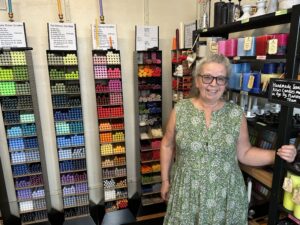
Silvia Shinn from Plaristo on the High Street is in favour of what the BID could do for Rye. She’s says it is worth the low charge for her business. “It’s a weekly cost of between £1.92 and £5.77 for us. If it attracts more people to our lovely town and leads to one more sale a week in our shop, we are already ahead. It’s value for money. I think it’s worth the risk.”
Also writing in Rye News she describes the idea as a “no-brainer.” Follow this link for more.
“There’s been a lack of consultation” says Mark Walter. “It hasn’t been fully explained, and people are still unaware they may have to pay. There are an awful lot of businesses in Rye that are not members of the chamber and who were completely unaware of it happening until just a couple of weeks ago. People who own big businesses and some of the pubs weren’t informed. It was misguided to instigate this without proper consultation.”
“Not so” says Sarah Broadbent. “The 277 businesses within the proposed BID area have all been sent four separate communications by post over the last eleven months including an online questionnaire, requests for businesses to join the task group, a newsletter, and an invitation to workshops. 170 businesses have also been visited either by task group members or by staff from the agency we’re working with to help steer us through the consultation. That’s 61% of the businesses within the BID area. The consultation period has been extended precisely so more businesses can request a meeting at their convenience.”
The heated online discussion has added to the controversy, judging by messages seen by Rye News. Mark Walter says some of the social media has been horrible. “The Rye BID has caused a clear divide between those who want it and those who don’t. It’s got a bit personal and I don’t agree with that.”
For Sarah Broadbent, from the Rye Bid Task Group, what’s needed now is for people from the 277 businesses affected to read the draft plan. “I hope they’ll ask more questions and ultimately vote on the final plan if we proceed that far. It won’t be for anyone else to determine.”
If approved, money raised by the Rye BID would begin to be spent this time next year.
Image Credits: KT Bruce , James Stewart .
Silvia Shinn says she is in favour of BID if it means more people to come to ‘our lovely Town.’
Rye seems to be at saturation point already with people … when I walk along the high street .
And they don’t just keep to the shops and other businesses …. The homes people live in have to cope with higher foot fall too.
Will it be just another tax that businesses are forced to pay whether they benefit on not. Or the profits they make. It’s always easier to use other people’s money.
Perhaps some of the money raised could be invested into the planting and upkeep of Rye’s public garden spaces. This would turn the plot next to the Landgate into an attractive area, rather than the eyesore it currently is.
Or people that care could get actively involved in their town and how it looks. Just a thought
I find it absurd that those who already pay extortionate rates should have to pay even more for things they should already be receiving. I agree with Judith about a problem that exists in many places: Why should residents pretty much anywhere have to put up with inconveniences that only a small handful profit from?
Why bother making a place nice if other people are then going to profit from your effort by having unwanted hordes trample all over it? Only a small but vociferous minority actually profit from Tourism.
I find this comment astounding. “A small but vociferous minority actually benefit from Tourism”. Was this meant ‘tongue in cheek’? I don’t know what your role is in the town but it is clearly nothing to do with retail, hospitality, art galleries, etc. The relatively small domestic population of Rye don’t on their own support the above average number of pubs, restaurants, a vibrant high street, art galleries, an independent cinema, shops that sell houseplants, or novelty floor mats, rug shops, antique shops, homewares (not just one but countless stores) an independent book shop, kitchen supplies shop, numerous clothing shops and so on. This town survives on those unwanted hordes. Like anything there needs to be a balance but the many many retailers, restauranteurs etc that exist because of those hordes will surely roll their eyes at this ridiculous statement. If you want to see what a similar town (and high street) of 4,000 or so people in a non tourist area looks like then please get out of Rye and look. Great for the vapers amongst you but not much more! You would be horrified.
Paolo, could it be that “the small domestic population of rye” is down to locals being unable to afford to live here, due to the many second homes/air b’n’b’s only tourists can afford? These same properties often stand empty when the holiday season is over and what locals there are do not necessarily need the novelty floor mats that tourists love to buy. You are correct – we do need a balance, but the scales appear to be tipped heavily in favour of tourists (and their many dogs) and to the detriment of local residents. Would the last person to leave after the tourist season is over, please turn out the lights.
Hear, hear. As I have stated (many times!) I live in Hastings Old Town and we have exactly the same issues with our local shops. Plenty of scented candles at extortionate prices but very few places for everyday goods, fresh vegetables, meat, etc. Pubs and restaurants have had to hike their charges due to rising overheads and tourists are the only people who can afford to patronise them. I have mild mobility issues and am “of a certain age”, which makes me apprehensive at walking along our overcrowded seafront (has anyone else noticed that entire groups/families take up the width of the pavement?). Many people like myself long for the end of the season, when we get our town back to ourselves. Sadly, this leaves us with empty streets and pubs etc…
This ‘idea’ that if all the tourists left, the closing candle shops and gift shops would miraculously be replaced by fruit and veg shops, affordable clothes retailers, shoe shops, hardware shops etc is total fantasy. Most high streets today are totally decimated places these days and in many places have become dangerous no-go areas full of boarded up shops and units available for rent. We have embraced the internet or out of town superstores. Close down the retail parks and the use of the internet, if you want to see a vibrant high street. Until you manage to do that, the tourists are at least stopping your high street from becoming dead zones. As to MD’s point above, I do get that the tourist trade has increased prices and this is concerning but even if Rye had the South East average property prices (taking the tourist premium out of the equation) property prices would still be shockingly high. That is a far bigger countrywide crisis.
I think the debate around this proposal is right and proper and there are advantages and disadvantages of such schemes which should be discussed and explored maturely. It may not be right for Rye or could be a a great way of allowing the local business to have more control over their own environment. Whether or not this is right for Rye is something that should come out of proper, respectful and informed debate.
As someone who is not a retail owner, it is not for me to express an opinion either way. I do know, however, from my own research into this, that these schemes are legitimate schemes with transparency, accountability and independent oversight with proper corporate governance and local authority engagement. What I do find disturbing and disappointing is the ill-informed, factually inaccurate and sometimes downright personal accusations that seem to be being swirled around by a minority few people through social media, petitions and personal approaches. Surely all people can have a healthy debate on this important matter without this kind of medieval style, witch hunt and pitchfork wielding type behaviour that would have been expected in Rye in 1525 not 2025.
Brilliantly stated Robert. I am also not a business owner so will abstain from an opinion but the vitriol is disappointing. Such a shame.
Could you please give some examples of the witch hunt and pitchfork wielding? Surely, if you put yourself in the place of a small retail business you would have some understanding?
Rye has a unique and strong identity, we live and work in a beautiful place with a history we can take pride in, from my understanding a BID would help to represent that unique identity in a powerful way to decision makers at a national as well as a local level. I agree with Sarah’s appraisal of the impact businesses could have in speaking with a unified voice to local government and national bodies at a time of fundamental change in local governance and a changing world.
I’m sad to hear the debate has descended into personal and divisive comments, James Stewart’s warning from a previous Rye News edition advising online restraint might be of use in these days of raised tempers and voices, our local Chamber do a brilliant job of representing business and amplifying the cause of commerce at a regional level, I know because I see how active they are with Rother and beyond. A recent example is the Short Term Let’s in Rye, Winchelsea and Camber task and finish group which I chaired, Sarah and Jane from the chamber presented a report they researched and wrote in their own time, with no rewards and promoted local business in a compelling way that had a real impact. Whether we agree or disagree with BID we are lucky to have such an effective Chamber.
One of the proposals from the T&F group was a tourist levy on overnight stays, a small amount added to the nightly charge that would benefit the town in the same way many European and some UK towns do now. Imagine how much Rye would benefit from even a £1 a night charge on the thousands of visitors we have. I understand some local hospitality venues don’t support this currently which is a shame however the only framework we could bring this in would be under the BID. This does give an example however of how even one objecting business can have an impact on decision making, that is a powerful means of check and balance in the proposal.
As you can tell, I see potential benefits to this but I am not a business owner, as always it’s important to listen and evaluate and for some, even a small charge will add pressures at a challenging time. What is at the heart of all of this is the importance of supporting our local business community, not just in words but in spending locally, when relevant – paying invoices on time (government legislation is enforcing timely payment) and crucially being realistic about what a town like Rye depends on to thrive and a large part of this is tourism. Ultimately of course this is a decision for our hardworking businesses to decide on and what we the ultimate decision, let’s avoid division and focus on dealing in facts, do your own research so you can be confident on reaching a decision that best benefits business and the wider community.
Christmas lights! Seriously – there really is more to life than Christmas lights.
Look at the ‘ideas’. Where is the substance to these suggestions? What are you going to do in the Strand? How are you putting any of this in place? What are your plans for the toilets? Absolutely no explanation whatsoever behind anything you are coming up with.
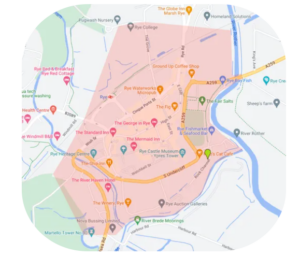
So that’s the map – the same area as used from the very beginning of all of this. Yet when I asked for the area and businesses involved, I was told it wasn’t decided.
The whole time frame has been changed. Everything has been moved forward – is that to stop our fight?
Why do some businesses still not know that the levy is non negotiable? It’s not opt in/out.
Why have you said that all those businesses have been visited when so many people haven’t seen any of you? Certainly in the Strand – an area that I am guessing wasn’t even thought of until I mentioned it at the meeting. I had hoped after that we may have seen someone.
This scheme is being run on the arrogance of a task force that know we can do nothing to stop this going ahead.
It has left the small businesses in this town utterly powerless.
Totally agree, the Strand is a focal point in Rye but gets Totally forgotten, as for visiting shop owners !! No one has directly spoken to myself or Annmarie about our two shops opposite you. Laughable comments. OK we are not there 7 days a week but both available by phone.
Personally, I don’t know many towns with a population of around 4,500 that have the facilities and vibrant atmosphere that we have in Rye. To me, this is what makes it a great place to live.
Without continuing to encourage tourism, in parallel with supporting our local businesses, I fear we risk losing the shops and services and events that make our lives in Rye pretty unique.
As political reorganisation is implemented over the nest two years, and public funding continues to decrease, it would seem that we will have to take more control of our own future … just look at the swimming pool as an example.
In this context, the effectiveness of BID, and any other initiatives that will help us adapt to future needs, needs careful consideration and we should at least be open to taking advantage of the limited support programmes that are available to us. Rye has shown itself to be a strong community as it is forced to take on increasing responsibility for itself. I think we need to continue to build on this.
I fear that the alternative is a gradual deterioration in our economic and social environment
Why is it down to business owners? Who already pay business rates, already contribute to a thriving high street and town, already employ people, create opportunity, donate to local events and school fetes, upkeep the buildings, attract tourists and take care of locals. Why is more pressure being put on business owners… ?
If this was a compulsory levy being imposed on residents who live in Rye, I am sure the response would be ‘well that is what I pay council tax for!’
Do some research on BIDs around the country and around the world. If you can find evidence of a successful BID, what it actually offers, what the investment payback is and how Rye could really benefit then please let us all know.
I have tried and all I can tell is that we could get some hanging baskets and a pavement cleaner…. Do we need a private company, run by a self appointed task force, collecting a compulsory levy from all business owners for this?
I am not against community coming together to make better, I am just not sure if this concept and the way it has been rolled out is the way forward. It has been divisive and opaque.
I think the debate is healthy and questions do need to be asked.
I believe Hastings has BID. As a start you could find out how that is going – how has the money raised been used – has it had a manifest impact?
At a BID workshop we were told by the BID experts, Mosaic consulting, that Hastings was not a good example of a BID and it had not been successful.
No point spending money on improving Rye if you can’t sort the public toilets out! The toilets by the station are utterly disgusting and disgraceful.
Just returned home from doing my weekly Jempsons shop and needed the loo whilst out!!! Well most had black bin bags over the toilet as no doubt out of order. I popped into one with no lock to find out the flush didn’t work. How can visitors, locals anyone enjoy Rye when they can’t even go to the loo. Soon this is what Rye will be known for not lovely shopping and atmosphere just disgusting unhygienic toilets…if you manage to get one. Just awful, hopefully Aldi will provide toilets that get cared for!
When did the Sheriff of Nottingham get placed in charge of Rye?
Small businesses in Rye are taxed enough and, in many cases, only just making ends meet. Extortionate rates, high tax, low growth economy and you’re talking about adding a levy on top of that? Crazy. Is the intention to see more businesses close down and go bust? The high street is already starting to have empty retail properties. Do you not want to help businesses to start up rather than add an additional hurdle and cost for them?
If you can afford it, great. Donate to a local improvement fund. Enforcing a levy on 277 businesses in Rye is undemocratic and wrong.
I have just been informed (9/01/26) today by the task force that I am to vote in a few days to re the BID. This is my first contact/consultation with the task force. NOT impressed. Just looked up Scarborough BID nightmare!! efforts with BID. where I lived before (no business then ) .
We at The Cinque Ports Arms are totally against this, we struggle enough with the cost of Utilities & overheads at the present time so why would we want to support something that is always about what certain members, in certain areas of the Town many who are relatively new to Rye ! Who seem to be able to take the reins & control how they want it run. What happened to us all being part of Rye not just the select few who seem to run it all how they want it to be run ? Nobody, has ever once approached us to discuss how some of us feel about this subject, apart from a flyer !!
My husband who has lived in Rye for over 50 years said it has always been the same – “Them & Us never about the town as a whole “
Jeremy & Ruth Sperring